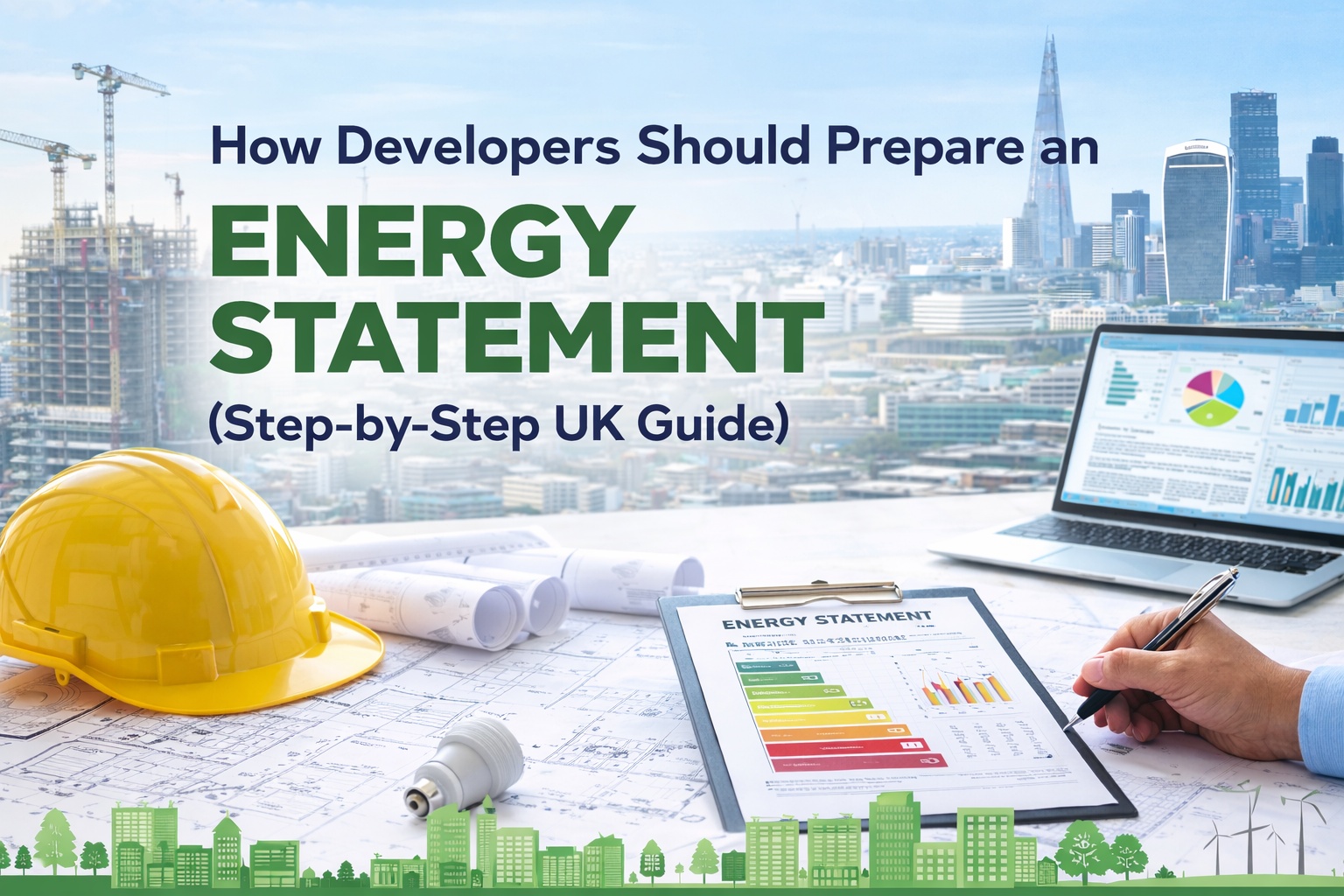
How Developers Should Prepare an Energy Statement (Step-by-Step UK Guide)
Preparing an Energy Statement for a planning application requires more than summarising sustainability intentions. Developers must align design decisions with local policy, complete accurate modelling and present measurable carbon reductions.
Across the UK, councils increasingly scrutinise energy performance at planning stage. Therefore, understanding the correct preparation process reduces delays, avoids redesign costs and improves approval confidence.
If you’re unsure whether your scheme requires one, first read our guide on When Do You Need an Energy Statement in the UK? before proceeding.
🔎 Step 1: Review Local Planning Policy First
Before undertaking any modelling, developers must review:
-
Local Plan energy policies
-
Carbon reduction targets
-
Renewable energy requirements
-
Sustainability thresholds
-
London Plan obligations (if applicable)
In London, developers must structure preparation around the London Plan energy hierarchy. Specifically, schemes must demonstrate compliance with “Be Lean, Be Clean, Be Green” and quantify carbon reductions beyond Building Regulations.
If you are preparing a planning application within Greater London, our dedicated Energy Statements London page outlines the additional compliance requirements in detail.
Skipping this step often leads to redesign and resubmission.
🧮 Step 2: Complete Formal Energy Modelling
An effective Energy Statement depends on structured modelling.
For residential developments, this involves SAP Calculations, which establish:
-
Dwelling Emission Rate (DER)
-
Target Emission Rate (TER)
-
Fabric Energy Efficiency
Commercial schemes require SBEM Calculations to assess energy demand and predicted carbon emissions.
Because modelling underpins the entire report, developers must ensure inputs match architectural drawings and system specifications precisely.
🌡️ Step 3: Address Overheating Requirements Early
Urban and high-density schemes frequently trigger overheating obligations.
Many councils now require Overheating Assessments (Part O / TM59) to demonstrate thermal comfort compliance. This requirement is particularly common in London boroughs.
By integrating overheating analysis at design stage, developers avoid costly glazing or ventilation redesign later.
🌬️ Step 4: Define an Airtightness Strategy
Airtightness significantly affects carbon performance calculations. Therefore, developers must define realistic air permeability targets early in the process.
The Energy Statement should outline predicted airtightness performance aligned with future Air Tightness Testing requirements.
Overly optimistic assumptions often lead to compliance gaps at Building Regulations stage.
🔋 Step 5: Develop a Quantified Carbon Reduction Strategy
Once baseline emissions are established, developers must demonstrate measurable improvements.
Typical strategies include:
-
Fabric-first upgrades
-
Enhanced insulation levels
-
Low-carbon heating systems such as heat pumps
-
Solar PV integration
-
Improved ventilation efficiency
Planning officers expect quantified reductions. Consequently, vague sustainability claims weaken applications.
📄 Step 6: Structure the Energy Statement Clearly
A professionally prepared Energy Statement should include:
-
Development overview
-
Planning policy review
-
Baseline performance modelling
-
Carbon reduction measures
-
Renewable energy strategy
-
Compliance summary
Clarity improves review efficiency. Therefore, the report should present modelling outputs logically and concisely.
For a complete overview of what is included, visit our Energy Statements for Planning Applications service page.
⚠️ Common Mistakes Developers Make
Even experienced teams encounter avoidable issues. Common mistakes include:
-
Beginning modelling before reviewing policy
-
Ignoring overheating requirements
-
Underestimating airtightness impact
-
Submitting incomplete modelling data
-
Failing to quantify carbon reductions
These oversights often result in validation delays, additional conditions or resubmission requests.
🏗️ Why Professional Coordination Matters
Although developers may understand sustainability principles, Energy Statements require integrated modelling expertise.
At Assessment Hive, we coordinate SAP, SBEM, overheating and airtightness strategy within a single structured workflow.
This integrated approach ensures:
-
Accurate modelling
-
Policy alignment
-
Reduced planning risk
-
Faster decision-making
Because regulations continue to tighten nationwide, early professional coordination protects both programme and budget.
✅ Step-by-Step Summary
Developers preparing an Energy Statement in the UK should:
1️⃣ Review local planning policy
2️⃣ Complete accurate SAP or SBEM modelling
3️⃣ Assess overheating requirements
4️⃣ Define airtightness targets
5️⃣ Quantify carbon reductions
6️⃣ Present findings in a structured compliance report
By following this process, you significantly improve planning approval confidence and reduce post-submission complications.
📞 Need Expert Support?
If your development requires an Energy Statement, we can coordinate the full process efficiently and compliantly.
📞 Call us on 020 7183 3240
📧 Email us at [email protected]
📝 Request Instant Quote → Click Here