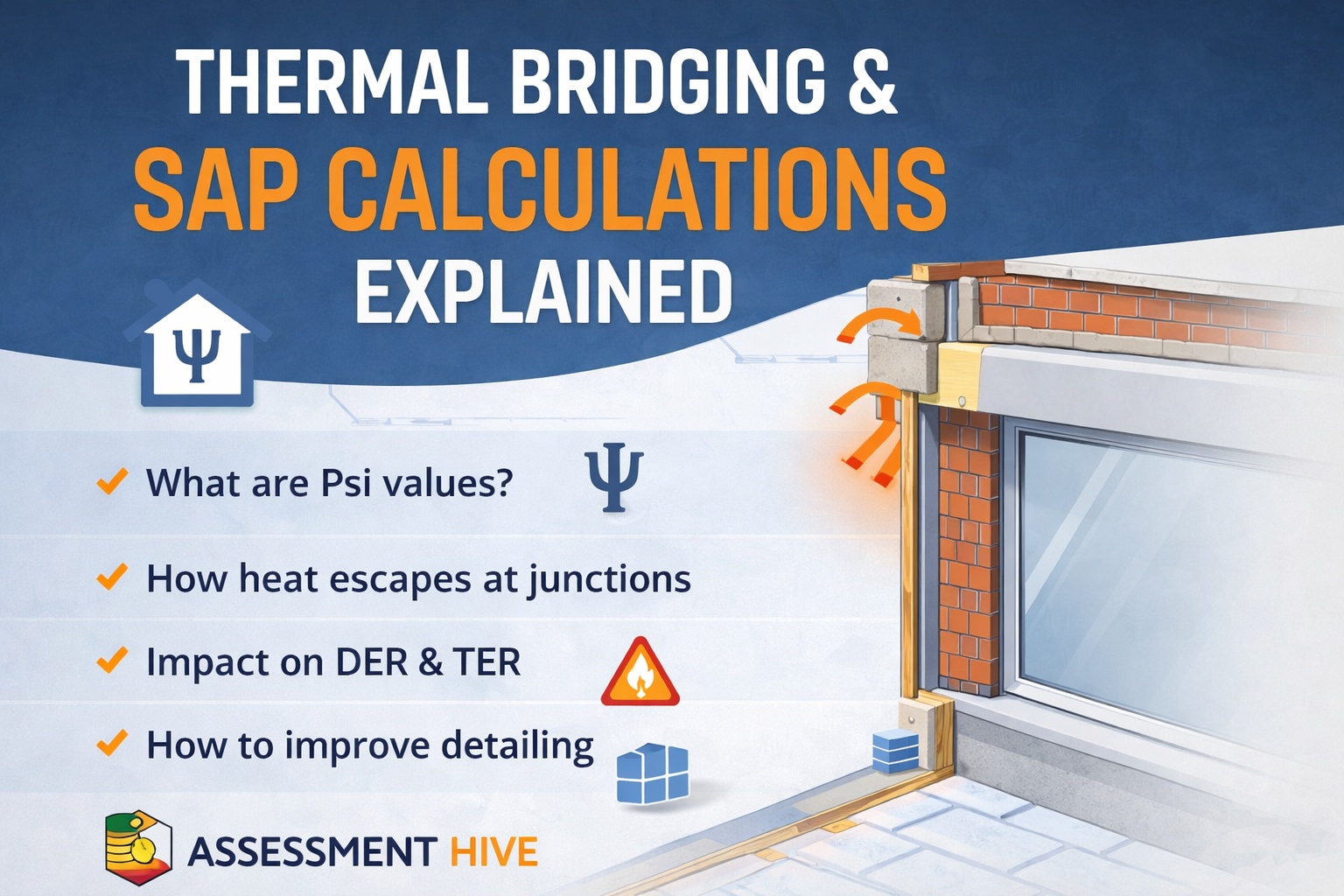
Thermal Bridging and SAP Calculations Explained
If you are working on a new build or conversion, understanding thermal bridging in SAP Calculations is essential for achieving Part L compliance.
Although insulation levels often receive most attention, thermal bridging can significantly impact your overall energy performance. In fact, poor detailing at junctions can increase heat loss and push your Dwelling Emission Rate (DER) above the Target Emission Rate (TER).
Therefore, addressing thermal bridging early in the design stage helps you avoid compliance issues later.
For a full overview of SAP compliance, visit our guide to SAP Calculations UK.
🔎 What Is Thermal Bridging?
Thermal bridging occurs where heat escapes through junctions in the building fabric.
Common locations include:
- Wall-to-floor junctions
- Wall-to-roof junctions
- Window and door openings
- Corners and edges
- Structural penetrations
Because these areas interrupt insulation continuity, they allow heat to flow more easily. As a result, thermal bridges increase overall heat loss and reduce energy efficiency.
📐 What Are Psi Values in SAP Calculations?
In SAP, thermal bridging is measured using Psi values (Ψ-values).
Psi values represent the rate of heat loss at junctions and are expressed in W/mK.
Lower Psi values indicate better performance. Therefore, improving junction detailing reduces heat loss and improves SAP results.
SAP combines Psi values across all junctions to calculate a thermal bridging factor, which directly influences DER.
⚖ How Thermal Bridging Affects DER vs TER
Thermal bridging plays a key role in determining whether your project passes SAP.
If junction performance is poor:
- Heat loss increases
- DER increases
- Compliance margins shrink
If junction performance improves:
- Heat loss decreases
- DER reduces
- Compliance margins strengthen
Because SAP compares DER against TER, even small improvements in thermal bridging can make the difference between passing and failing.
For a full explanation of this relationship, read DER vs TER Explained.
🏗 Accredited Construction Details vs Custom Psi Values
There are two main approaches to thermal bridging in SAP Calculations.
1️⃣ Accredited Construction Details (ACDs)
ACDs provide standardised junction details with pre-approved Psi values.
Advantages:
- Faster modelling
- No need for bespoke calculations
- Widely accepted by Building Control
However, ACDs may not always offer the best performance.
2️⃣ Bespoke / Calculated Psi Values
Alternatively, you can use project-specific junction calculations.
Advantages:
- Lower Psi values
- Improved energy performance
- Greater control over compliance
However, this approach requires specialist input and additional calculation work.
📉 Why Thermal Bridging Causes SAP Failure
Many projects fail SAP because thermal bridging is overlooked.
Common issues include:
- Missing junction details
- Default SAP assumptions used incorrectly
- Poor construction detailing
- Lack of coordination between design and build
In many cases, teams focus on insulation thickness while ignoring junction performance. Consequently, DER increases unexpectedly.
To understand how these issues lead to rejection, read why Building Control reject SAP reports.
📈 How to Improve Thermal Bridging Performance
Improving thermal bridging does not always require major redesign. Instead, targeted changes can significantly improve results.
For example:
- Use continuous insulation at junctions
- Reduce gaps between materials
- Specify improved window installation details
- Minimise structural penetrations
- Use accredited or calculated junction details
Because these changes reduce heat loss, they help lower DER and strengthen compliance margins.
For broader optimisation strategies, read how to improve your SAP score before submission.
🏠 Thermal Bridging in New Builds
In new build projects, you have greater control over junction detailing.
Therefore, addressing thermal bridging early allows you to:
- Improve compliance margins
- Reduce reliance on renewables
- Optimise construction details
If you are working on a new dwelling, see SAP Calculations for New Builds for full guidance.
🏢 Thermal Bridging in Conversions
Conversions present additional challenges.
Existing structures often:
- Limit insulation continuity
- Introduce complex junctions
- Require internal insulation solutions
As a result, thermal bridging can significantly impact performance.
If you are working on a conversion project, visit SAP Calculations for Conversions.
🌬 Interaction with Airtightness
Thermal bridging and airtightness often work together.
Even if insulation performs well, poor airtightness can increase heat loss. Similarly, strong airtightness combined with poor junction detailing still reduces performance.
Therefore, coordinating thermal bridging with Air Tightness Testing improves overall results.
🧱 Fabric-First Strategy and Thermal Bridging
Thermal bridging forms a key part of a fabric-first approach.
By improving junction performance, you:
- Reduce energy demand
- Improve long-term efficiency
- Strengthen SAP compliance
Although renewable technologies can help, fabric improvements provide more stable performance.
📊 Quick Summary: Thermal Bridging in SAP
- Thermal bridging occurs at junctions in the building fabric
- Psi values measure junction heat loss
- Lower Psi values improve energy performance
- Thermal bridging directly affects DER
- Poor detailing can cause SAP failure
- Early design coordination improves compliance
📌 Final Thoughts
Thermal bridging is often overlooked, yet it plays a critical role in SAP compliance.
Rather than focusing only on insulation thickness, consider how junctions perform across the entire building. By addressing thermal bridging early, you reduce heat loss, improve DER and avoid late-stage redesign.
For a complete overview of compliance, return to SAP Calculations UK, or contact our team to review your project.
-
 Fast turnaround
 -
 Competitive pricing
 -
 Remote, nationwide service
 Call us on 020 7183 3240
 Email us at [email protected]
 Request Instant Quote → Click Here