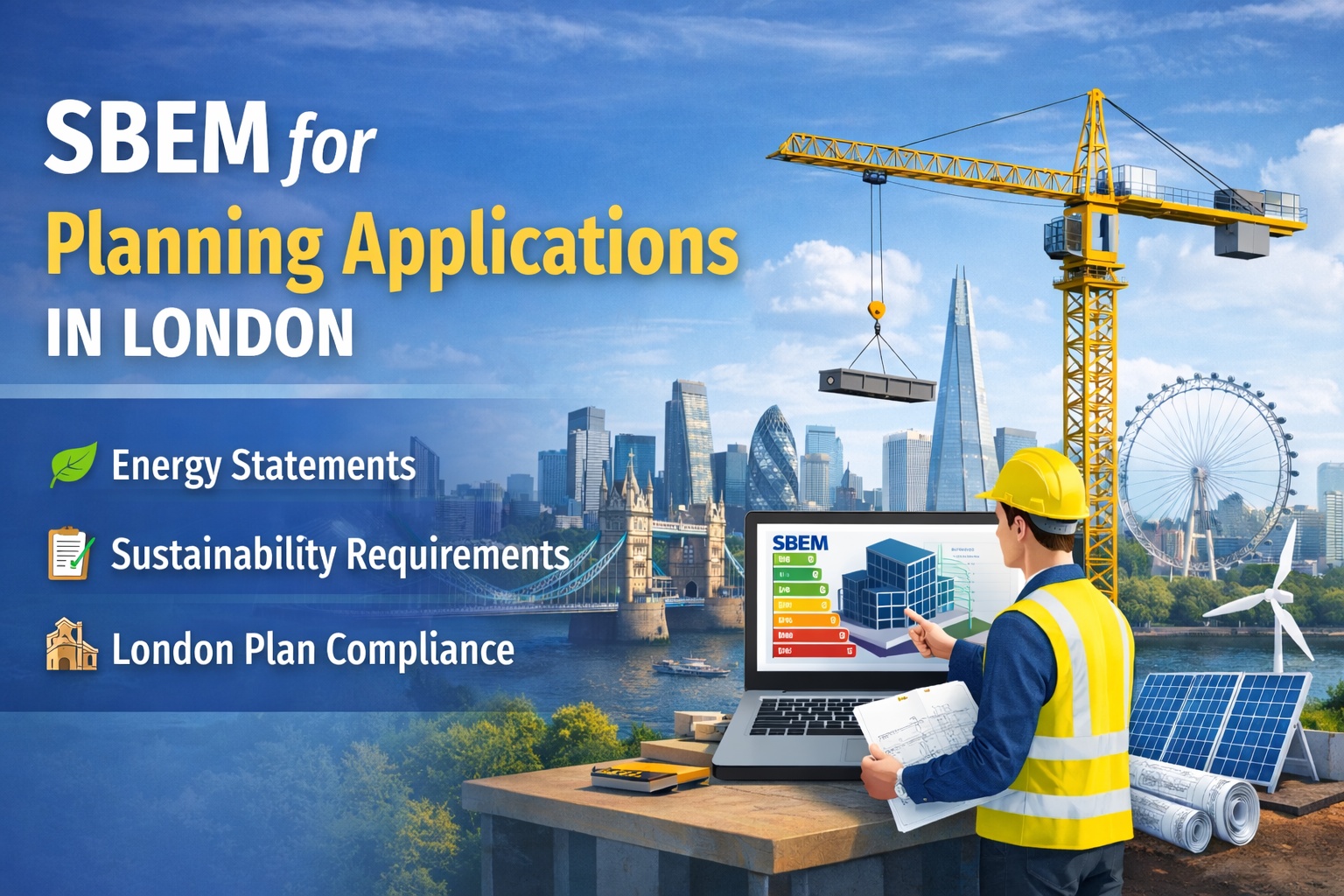
What Is SBEM and How Does It Support Planning?
SBEM (Simplified Building Energy Model) measures the energy performance of non-domestic buildings.
It calculates:
- Carbon emissions
- Energy consumption
- Fabric performance
- Heating and cooling efficiency
- Ventilation and lighting demand
At planning stage, SBEM provides quantifiable energy data that supports sustainability reports and demonstrates how a development will reduce carbon emissions.
As a result, planning officers and consultants can assess whether a scheme aligns with local and regional policy requirements.
For a full overview, read our guide on SBEM Calculations London, which explains how modelling supports commercial development.
🏛 Why SBEM Is Important for Planning in London
Planning requirements in London go beyond national Building Regulations.
Developments must align with policies influenced by the Greater London Authority and strategic guidance within the London Plan.
These policies require developments to follow the London energy hierarchy:
- Be Lean – reduce energy demand
- Be Clean – supply energy efficiently
- Be Green – use renewable energy
SBEM modelling helps demonstrate compliance with these principles by providing detailed performance data.
Therefore, developers often use SBEM calculations to support planning submissions and reduce the risk of objections.
🧾 SBEM and Energy Statements for Planning Applications
In most London boroughs, developers must submit an energy strategy alongside planning applications.
By aligning SBEM modelling with your Energy Statement for planning applications in London, you can create a consistent, evidence-based submission that addresses London Plan requirements.
Energy Statements demonstrate :-
- Carbon reduction strategies
- Energy efficiency measures
- Use of low and zero carbon technologies
- Compliance with local planning policy
SBEM modelling provides the data required to support these reports.
By aligning SBEM modelling with your Energy Statements, you create a consistent and evidence-based planning submission.
🏗 When Should SBEM Be Completed for Planning?
Developers should complete SBEM modelling as early as possible during the design stage.
Early modelling allows the design team to:
- Identify potential compliance issues
- Adjust glazing ratios
- Improve insulation performance
- Optimise building services
- Strengthen planning submissions
As a result, early SBEM modelling reduces redesign risk and improves planning success rates.
If you are unsure whether your project requires modelling, read our guide When Are SBEM Calculations Required in London?
🌬 Air Tightness and Planning Strategy
Air permeability assumptions influence both SBEM modelling and planning strategies.
Although air tightness testing occurs after construction, designers must define realistic targets during the design stage.
Therefore, coordinating SBEM modelling with air tightness strategy ensures that predicted performance aligns with real-world results.
This helps avoid discrepancies between planning assumptions and final compliance outcomes.
⚖ SBEM vs SAP for Planning Applications
Many London developments include both residential and commercial elements.
In these cases:
- Commercial areas require SBEM modelling
- Residential areas require SAP Calculations
For example:
- Ground floor retail units → SBEM
- Residential flats above → SAP
Understanding this distinction is essential when preparing planning applications.
To learn more, read our guide SAP vs SBEM – What’s the Difference?
💷 How Much Do SBEM Calculations Cost for Planning?
The cost of SBEM modelling depends on building size, complexity and services.
Typical London pricing includes:
- Small commercial unit → £500 – £850
- Medium development → £850 – £1,600
- Large schemes → £1,600+
However, early modelling often saves money by preventing costly design changes later.
For a detailed breakdown, read our guide How Much Do SBEM Calculations Cost in London?
🧾 From Planning to Final Certification
While SBEM modelling plays a key role during the planning stage, compliance does not end there.
Once construction is complete, the building must achieve final certification before it can be occupied, sold or leased. This is achieved through a Commercial EPC Assessment, which uses the SBEM model alongside the final as-built building data to determine the building’s energy rating.
By considering both SBEM and EPC requirements early, developers can ensure a smoother transition from planning approval to final compliance.
📋 What Information Is Required for Planning Stage SBEM?
To complete SBEM modelling for planning applications, assessors typically require:
- Architectural drawings
- Elevations and sections
- Construction specifications
- Glazing performance data
- HVAC system details
- Lighting layouts
- Ventilation strategy
- Air permeability assumptions
Providing this information early improves modelling accuracy and speeds up the planning process.
📍 SBEM for Planning Across London Boroughs
Assessment Hive supports planning applications across all London boroughs, including:
- Camden
- Barnet
- Enfield
- Westminster
- Islington
- Hackney
- Kensington & Chelsea
Because our service operates remotely, we support developments across Greater London.
❓ Frequently Asked Questions
Do I need SBEM Calculations for planning permission in London?
In many cases, yes. While SBEM is not always mandatory at planning stage, developers often use it to support Energy Statements and demonstrate compliance with sustainability policies.
Can I submit a planning application without SBEM?
You may be able to. However, many London boroughs expect energy modelling data as part of sustainability reporting. Without it, your application may face delays or requests for additional information.
When should SBEM be completed for planning?
You should complete SBEM modelling during the early design stage. This allows the design team to refine the building before submitting the planning application.
From Planning to Building Completion
SBEM modelling can begin during the planning and design stages, but the energy compliance journey continues through construction and completion. Keeping the energy model aligned with the final specification helps reduce discrepancies later in the project.
For applicable new commercial buildings, the completion process can ultimately lead to the production of a Commercial Energy Performance Certificate (EPC).
🚀 Get SBEM Support for Your London Planning Application
If you are preparing a planning application in London, Assessment Hive provides expert SBEM modelling to support your submission.
We offer:
- Fixed transparent pricing
- Fast turnaround times
- Full compliance support
- Integration with Energy Statements and EPC requirements
Contact Assessment Hive today. We will review your drawings, assess compliance risk and provide a clear, fixed-fee proposal.
-
 Fast turnaround
 -
 Competitive pricing
 -
 Remote, nationwide service
 Call us on 020 7183 3240
 Email us at [email protected]
 Request Instant Quote → Click Here