SBEM Calculations for Commercial Extensions (UK & London Guide)
If you are planning a commercial extension, you may be wondering whether SBEM Calculations are required.
In many cases, the answer is yes.
Developers must often demonstrate compliance with Building Regulations Part L when extending non-domestic buildings. Therefore, SBEM modelling plays a key role in ensuring your extension meets energy efficiency standards.
Understanding when SBEM applies — and how to achieve compliance — will help you avoid delays and keep your project moving forward.
📘 Do You Need SBEM Calculations for a Commercial Extension?
In most situations, you will require SBEM Calculations if your extension:
- Increases the total floor area significantly
- Introduces new building services (heating, cooling or ventilation)
- Alters the thermal performance of the building
Building Control uses SBEM modelling to assess whether the extension meets current energy standards.
For a full overview of how compliance works, read our guide on SBEM Calculations.
⚖ When SBEM May Not Be Required
In some cases, SBEM modelling may not be necessary.
For example:
- Very small extensions
- Minor alterations with no impact on energy performance
- Projects that fall under simplified compliance routes
However, most commercial extensions still require some level of energy assessment. Therefore, it is always best to confirm requirements early.
🏗 What Does SBEM Assess for Extensions?
SBEM modelling evaluates how the extension affects overall building performance.
It considers:
- Building fabric (walls, floors and roofs)
- Glazing performance
- Heating and cooling systems
- Ventilation strategy
- Lighting efficiency
As a result, the model determines whether the extension meets Part L requirements.
🧱 Common Reasons Extensions Fail SBEM
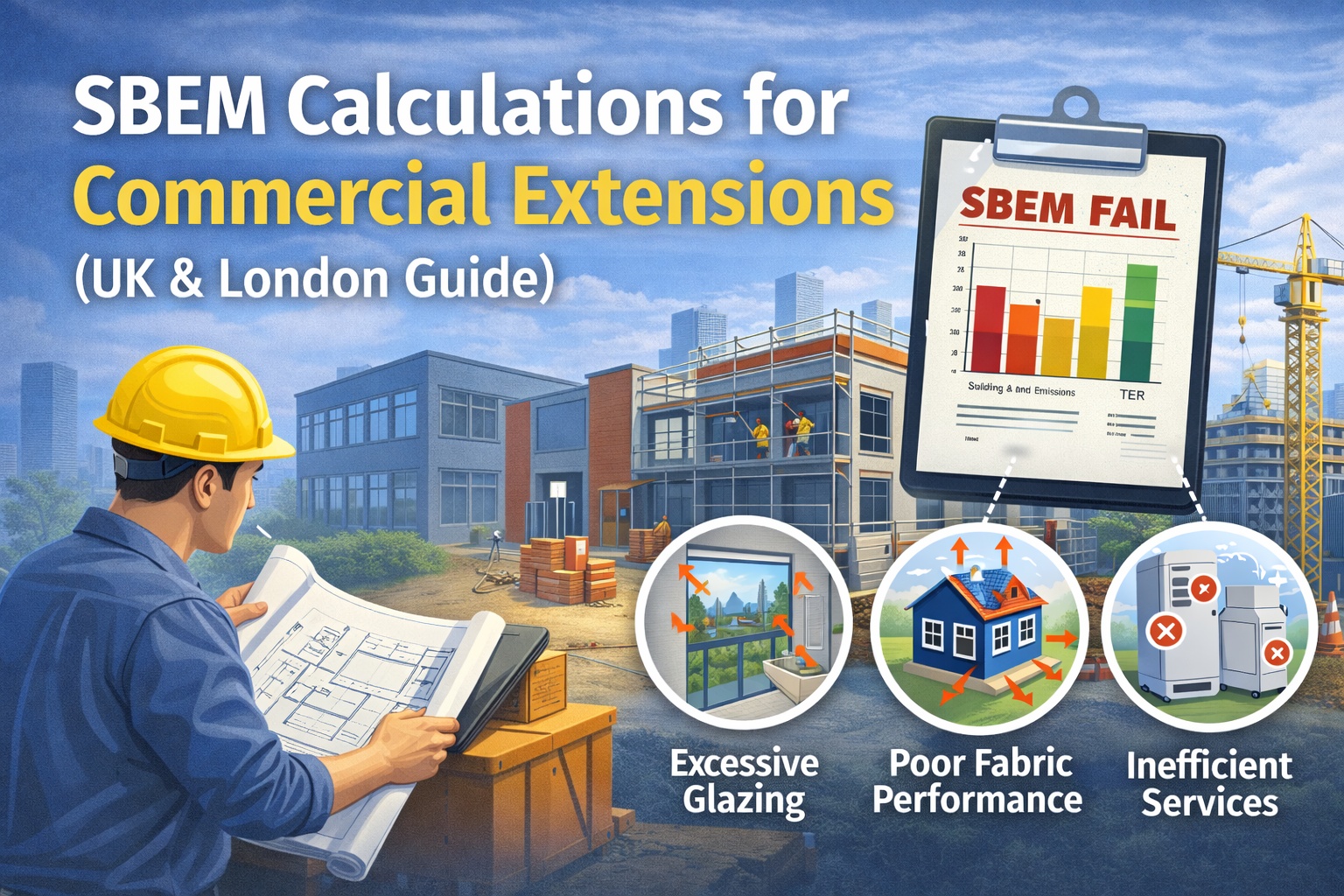
Extensions often fail SBEM due to design decisions made early in the project.
🪟 Excessive Glazing
Large glazed areas can reduce thermal efficiency.
Although glazing improves natural light, it increases heat loss. Therefore, designers must balance aesthetics with performance.
🧱 Poor Fabric Standards
If the extension has weak insulation or high U-values, energy performance drops.
Consequently, the building may fail compliance.
🔥 Inefficient Systems
New systems must meet modern efficiency standards.
If heating, cooling or ventilation systems are poorly specified, the model may fail.
🌬 Air Leakage
Poor air tightness assumptions can negatively impact results.
Therefore, designers should aim for realistic and achievable targets.
👉 If your design does not meet compliance targets, read What Happens If You Fail SBEM Calculations? to understand how to fix common issues.
🛠 How to Pass SBEM for Extensions
The good news is that most extensions can achieve compliance with the right approach.
🔧 Improve Fabric Performance
Start by upgrading insulation and construction details.
This includes:
- Lower U-values
- Better glazing
- Reduced thermal bridging
⚙ Upgrade Building Services
Modern, efficient systems improve results significantly.
Options include:
- High-efficiency boilers
- Heat pumps
- Smart controls
🌞 Add Renewable Energy
Renewable systems can offset emissions.
For example:
- Solar PV
- Low-carbon technologies
⚖ Optimise the Design
Small adjustments can make a big difference.
For example:
- Reduce glazing ratios
- Improve layout
- Lower energy demand
🏙 SBEM for Extensions in London
Commercial extensions in London often face stricter requirements.
Developments must align with policies influenced by the London Plan. As a result, developers often carry out modelling earlier in the design process.
In addition, many projects require planning documentation such as Energy Statements.
👉 Read SBEM Calculations London to understand how compliance works in the capital.
👉 You should also review SBEM for Planning Applications in London, which explains how modelling supports planning approval.
🧾 Do Extensions Require Energy Statements?
In London, many commercial extensions require supporting planning documentation.
Developers often prepare Energy Statements for planning applications to demonstrate:
- Carbon reduction
- Energy efficiency
- Compliance with planning policy
SBEM modelling provides the data required to support these reports.
🧾 Will a Commercial Extension need an EPC?
Depending on the scope of the project and the circumstances of the building, EPC requirements may also need to be considered following commercial alteration or extension works.
If you are unsure how the certificate fits alongside SBEM compliance, read our guide explaining what a Commercial EPC is and when it may be required.
💷 How Much Do SBEM Calculations Cost for Extensions?
The cost of SBEM modelling depends on:
- Extension size
- Complexity
- Building services
Typical costs include:
- Small extensions → £300 – £850
- Medium extensions → £850 – £1,600
- Large extensions → £1,600+
For a full breakdown, read:
⏱ When Should You Carry Out SBEM?
You should complete SBEM modelling during the design stage.
This allows you to:
- Identify issues early
- Adjust the design
- Avoid costly changes
As a result, early modelling helps keep your project on schedule.
❓ Frequently Asked Questions
Do all commercial extensions require SBEM?
Not all. However, most extensions that involve new services or significant changes will require SBEM modelling.
Can I complete an extension without SBEM?
In some cases, yes. However, most commercial projects still require energy compliance checks.
How can I avoid failing SBEM?
You can avoid failure by carrying out modelling early and working with experienced assessors.
🚀 Get SBEM Calculations for Your Extension
If you are planning a commercial extension, Assessment Hive provides expert SBEM modelling to ensure compliance.
We offer:
- Fast turnaround times
- Fixed transparent pricing
- Full compliance support
- Design optimisation advice
-
 Fast turnaround
 -
 Competitive pricing
 -
 Remote, nationwide service
 Call us on 020 7183 3240
 Email us at [email protected]
 Request Instant Quote → Click Here