Energy Statements for Planning Applications in London
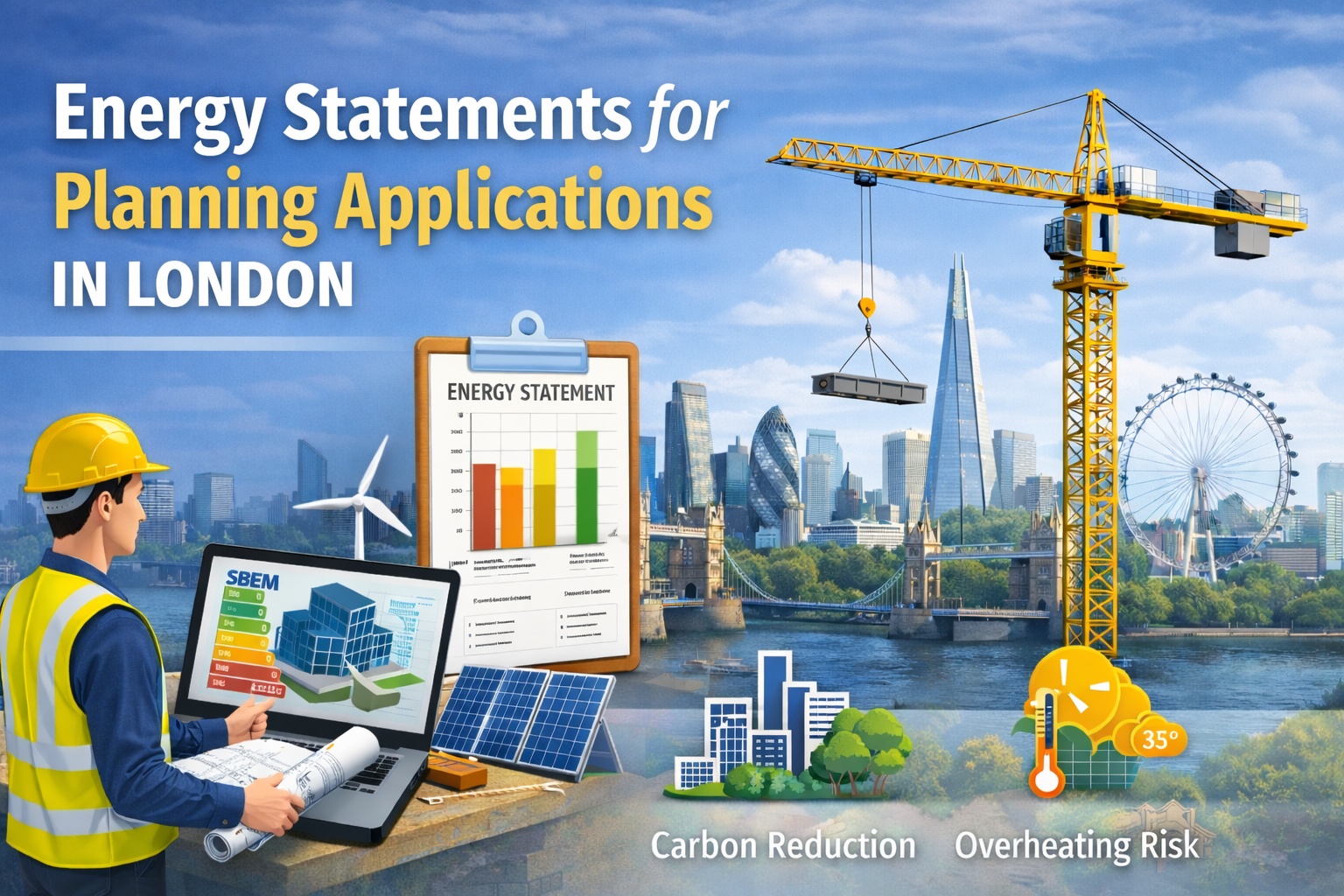
If you are submitting a planning application in London, you will often need to provide an Energy Statement.
Local planning authorities expect developers to demonstrate how their proposals reduce carbon emissions and improve energy efficiency. Therefore, an Energy Statement plays a critical role in securing planning approval.
At Assessment Hive, we produce professional Energy Statements for planning applications in London, helping developers meet policy requirements and move projects forward with confidence.
📘 What Is an Energy Statement?
An Energy Statement is a technical report submitted as part of a planning application. It explains how a development meets energy efficiency and carbon reduction targets.
Typically, an Energy Statement includes:
- Predicted energy demand
- Carbon emission calculations
- Fabric efficiency strategy
- Heating and cooling systems
- Renewable energy proposals
- Compliance with planning policy
These reports support sustainability objectives set by the Greater London Authority and outlined in the London Plan.
🏛 Why Energy Statements Are Required in London
London has some of the most demanding sustainability policies in the UK.
Developments must follow the London energy hierarchy:
- Be Lean – reduce energy demand
- Be Clean – supply energy efficiently
- Be Green – use renewable energy
Planning officers assess Energy Statements to confirm that developments meet these requirements.
As a result, a well-prepared Energy Statement can significantly improve the chances of planning approval.
🧱 What Does an Energy Statement Include?
A comprehensive Energy Statement for a London development typically includes several key sections.
Energy Demand Assessment
Firstly, the report calculates baseline energy demand for the proposed development.
Fabric Energy Efficiency
Next, it explains how insulation, glazing and construction materials reduce heat loss.
Building Services Strategy
The report outlines heating, cooling and ventilation systems.
Carbon Emissions Calculations
It demonstrates how the development reduces CO₂ emissions.
Renewable Energy Strategy
Finally, it assesses technologies such as solar PV and heat pumps.
Together, these elements provide a clear energy strategy for the development.
🔗 How SBEM Supports Energy Statements
For commercial developments, SBEM modelling plays a key role in producing accurate Energy Statements.
SBEM Calculations London provide:
- Verified carbon emission data
- Energy performance modelling
- Compliance evidence for planning
For a detailed explanation, read our guide SBEM for Planning Applications in London, which explains how modelling supports planning submissions.
In many cases, developers carry out SBEM modelling early in the design process to strengthen their Energy Statement.
🏗 Energy Statements for Residential vs Commercial Projects
Energy Statements apply to both residential and commercial developments.
However, the methodology differs:
- Commercial developments → SBEM Calculations
- Residential developments → SAP Calculations
For mixed-use schemes:
- Ground floor retail → SBEM
- Residential units above → SAP
To understand this in more detail, read our guide SAP vs SBEM – What’s the Difference?
🌬 Air Tightness and Energy Strategy
Air permeability plays an important role in energy efficiency.
Designers must consider air tightness early in the project because it directly affects:
- Heat loss
- Energy consumption
- Carbon emissions
Although testing occurs after construction, the Energy Statement must include realistic air permeability assumptions.
Therefore, coordinate early with your Air Tightness Testing strategy and design airtightness details carefully.
🌡 Overheating Risk and Energy Statements in London
In addition to energy efficiency and carbon reduction, London planning policies increasingly require developers to consider overheating risk. This is especially important for residential and mixed-use developments, where internal temperatures can rise significantly due to solar gains, glazing ratios and urban heat effects.
As a result, many planning authorities expect developers to demonstrate compliance with Part O of the Building Regulations. To achieve this, designers often carry out Overheating Assessments alongside energy modelling.
An Overheating Assessment evaluates factors such as:
- Solar gains through glazing
- Ventilation strategy
- Thermal mass
- Orientation and shading
By combining overheating analysis with your Energy Statement, you create a more robust and policy-compliant planning submission. Furthermore, this integrated approach helps ensure that the building performs well not only in terms of energy efficiency but also in occupant comfort.
💷 How Much Do Energy Statements Cost in London?
The cost of an Energy Statement depends on several factors, including:
- Development size
- Building complexity
- Number of units or zones
- Level of detail required
However, typical costs range from:
- Small projects → £500 – £1,000
- Medium developments → £1,000 – £2,500
- Large schemes → £2,500+
Because Energy Statements support planning approval, they represent a small but essential investment in the overall project.
If you would like a more detailed breakdown of pricing factors and what influences fees, read our guide on Energy Statement Cost UK.
🧾 From Planning to Final Compliance
Energy Statements form part of the planning process. However, compliance continues beyond approval.
During the design stage, developers use SBEM or SAP modelling to refine the energy strategy. Once construction finishes, an accredited assessor produces a Commercial EPC or Residential EPC certificate.
This ensures that the completed building achieves the predicted energy performance.
📋 What Information Is Required?
To prepare an Energy Statement, assessors typically require:
- Architectural drawings
- Site layout plans
- Construction specifications
- Glazing details
- Heating and cooling systems
- Ventilation strategy
- Renewable energy proposals
Providing complete information early helps produce accurate reports and avoid planning delays.
📍 Energy Statements Across London Boroughs
Assessment Hive provides Energy Statements for developments across all London boroughs, including:
- Camden
- Barnet
- Enfield
- Westminster
- Islington
- Hackney
- Kensington & Chelsea
Because our service is remote, we support projects throughout Greater London.
❓ Frequently Asked Questions
Do I need an Energy Statement for planning in London?
In most cases, yes. Many London boroughs require Energy Statements for new developments and major refurbishments to demonstrate compliance with sustainability policies.
When should an Energy Statement be prepared?
You should prepare an Energy Statement during the early design stage. This allows developers to refine the design before submitting a planning application.
Can I submit planning without an Energy Statement?
In some cases, yes. However, most London planning authorities will request one for larger or more complex developments, which may delay approval.
🚀 Get an Energy Statement for Your London Project
If you are preparing a planning application, Assessment Hive provides expert Energy Statements tailored to London developments.
We offer:
- Fast turnaround times
- Fixed transparent pricing
- Full compliance with London planning policy
- Integration with SBEM and SAP calculations
 Call us on 020 7183 3240
 Email us at [email protected]
 Request Instant Quote → Click Here