What Is Included in a SAP Report? | Complete Guide
If you’ve been told you need SAP Calculations, you may also be wondering what information is actually included in the final report.
A SAP report contains much more than a simple pass or fail result. It provides a detailed assessment of a property’s predicted energy performance and demonstrates compliance with Building Regulations Part L. Building Control uses this information to confirm that a new dwelling, conversion or qualifying extension meets the required energy standards.
In this guide, we explain what a SAP report includes, why each section matters and how the report supports your project from design stage through to completion.
For a complete overview of the SAP process, visit our SAP Calculations UK guide.
📋 What Is a SAP Report?
A SAP report is an official document produced by an accredited SAP assessor using approved government software.
The report predicts how efficiently a residential property will use energy and whether it complies with Building Regulations Part L.
Depending on the stage of your project, you may receive:
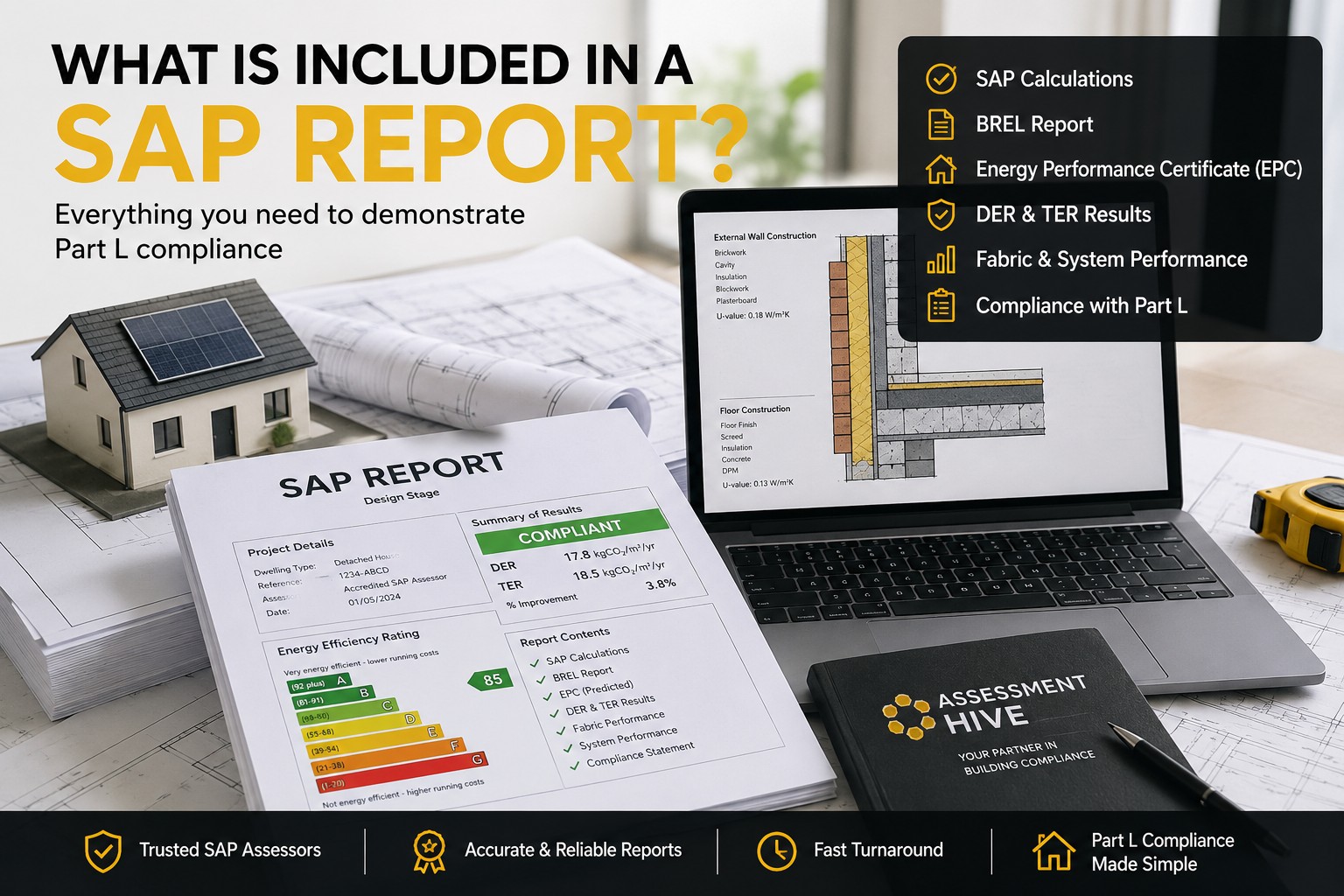
- Design Stage SAP Report
- As Built SAP Report
- Predicted Energy Performance Certificate (EPC)
- Final Energy Performance Certificate (EPC)
Together, these documents demonstrate compliance before and after construction.
📄 What is included in the As Designed SAP Compliance Pack?
All projects require a compliance pack for submission to Building Control.
This typically includes:
- Executive Summary showing how compliance has been met
- Design Stage SAP Calculations
- BREL Report (if applicable)
- Predicted EPC (if applicable)
- U-value calculations and Property Specification
- Psi-value information (where applicable)
Together, these documents demonstrate that the proposed dwelling satisfies Part L before construction starts.
🏁 What Does the As Built SAP Report Include?
Once construction finishes, the SAP report is updated to reflect the completed dwelling.
The As Built package generally includes:
- Final SAP Calculations
- As Built BREL Report (if applicable)
- Final Energy Performance Certificate
- Confirmed construction specifications
- Final air permeability result
- Updated heating system details
This information allows Building Control to issue final approval.
📊 Key Performance Figures Within a SAP Report
A SAP report contains several important performance indicators.
Dwelling Emission Rate (DER)
DER measures the predicted carbon emissions from the dwelling.
To understand this in more detail, read DER vs TER Explained.
Target Emission Rate (TER)
TER is the regulatory benchmark your project must achieve.
The proposed design must perform at least as well as this target.
Primary Energy
Primary Energy measures the total energy required to operate the dwelling over a year.
It forms an important part of modern Part L compliance.
Fabric Energy Efficiency (FEE)
Fabric Energy Efficiency measures how effectively the building envelope reduces heat loss.
Improving insulation, airtightness and junction detailing all contribute to better FEE results.
For further guidance, read Fabric First Strategy in SAP Calculations.
🌬 Air Tightness Information
Your SAP report includes an assumed air permeability value during the design stage.
Once construction finishes, the actual air test result replaces this assumption.
If the measured value differs significantly, compliance may change.
Learn more in How Air Tightness Impacts SAP Calculations.
🧱 Thermal Bridging Information
The report also considers heat loss through construction junctions.
Where project-specific psi-values are available, these improve the accuracy of SAP modelling.
To understand why this matters, read Thermal Bridging in SAP Calculations.
🏡 Which Projects Require a SAP Report?
SAP reports are commonly required for:
- New build houses
- New build flats
- Self-build homes
- Office-to-residential conversions
- Barn conversions
- Some highly glazed extensions
For project-specific guidance, visit:
🏙 SAP Reports and London Developments
Many London developments require both planning-stage sustainability documents and Building Regulations compliance.
Where an Energy Statement specifies insulation levels, heating systems or renewable technologies, the SAP report should reflect those same assumptions.
Coordinating both documents helps avoid approval delays.
For location-specific guidance, see SAP Calculations London.
⚠ Common Mistakes Found in SAP Reports
Errors within a SAP report can delay Building Control approval.
Common issues include:
- Incorrect insulation specifications
- Heating system changes during construction
- Missing thermal bridging information
- Unrealistic air permeability assumptions
- Incomplete documentation
If these issues affect compliance, read What Happens If You Fail SAP Calculations?
📈 How to Improve the Results in a SAP Report
You can often improve SAP performance by:
- Increasing insulation levels
- Reducing thermal bridging
- Improving airtightness
- Upgrading glazing
- Installing efficient heating systems
- Adding renewable technologies
For practical advice, read How to Improve Your SAP Score Before Submission.
👷 Why Work With an Experienced SAP Assessor?
An experienced SAP assessor does far more than produce a report.
They also help you:
- Identify compliance risks early
- Recommend cost-effective improvements
- Reduce redesign during construction
- Achieve Building Control approval more smoothly
Early involvement often saves both time and money.
🧠 Final Thoughts
A SAP report provides the technical evidence needed to demonstrate compliance with Building Regulations Part L.
More importantly, it helps ensure your development performs efficiently, achieves the required standards and progresses through Building Control with fewer delays.
By working with an experienced SAP assessor from the design stage, you can identify issues early and keep your project on track.
❓ Frequently Asked Questions
What documents are included in a SAP report?
Most projects receive SAP Calculations, a BREL Report, a Predicted EPC (design stage) and a Final EPC (as built), along with supporting compliance information.
Does every new build need a SAP report?
Yes. Every new residential dwelling requires SAP Calculations to demonstrate compliance with Building Regulations Part L.
What is the difference between a Design Stage and As Built SAP report?
The Design Stage report assesses the proposed specification before construction. The As Built report confirms the completed dwelling matches the final construction details.
Can Building Control reject a SAP report?
Yes. If the report contains incorrect information or demonstrates non-compliance with Part L, Building Control may require amendments before issuing approval.
How long does it take to produce a SAP report?
Most residential SAP reports are completed within a few working days once all drawings and specifications have been received.
 Request a SAP Calculations UK Quote
Planning a new build, extension or conversion?
Contact Assessment Hive today. We will review your drawings, assess compliance risk and provide a clear, fixed-fee proposal.
-
 Fast turnaround
 -
 Competitive pricing
 -
 Remote, nationwide service
 Call us on 020 3745 1093
 Email us at [email protected]
 Request Instant Quote → Click Here