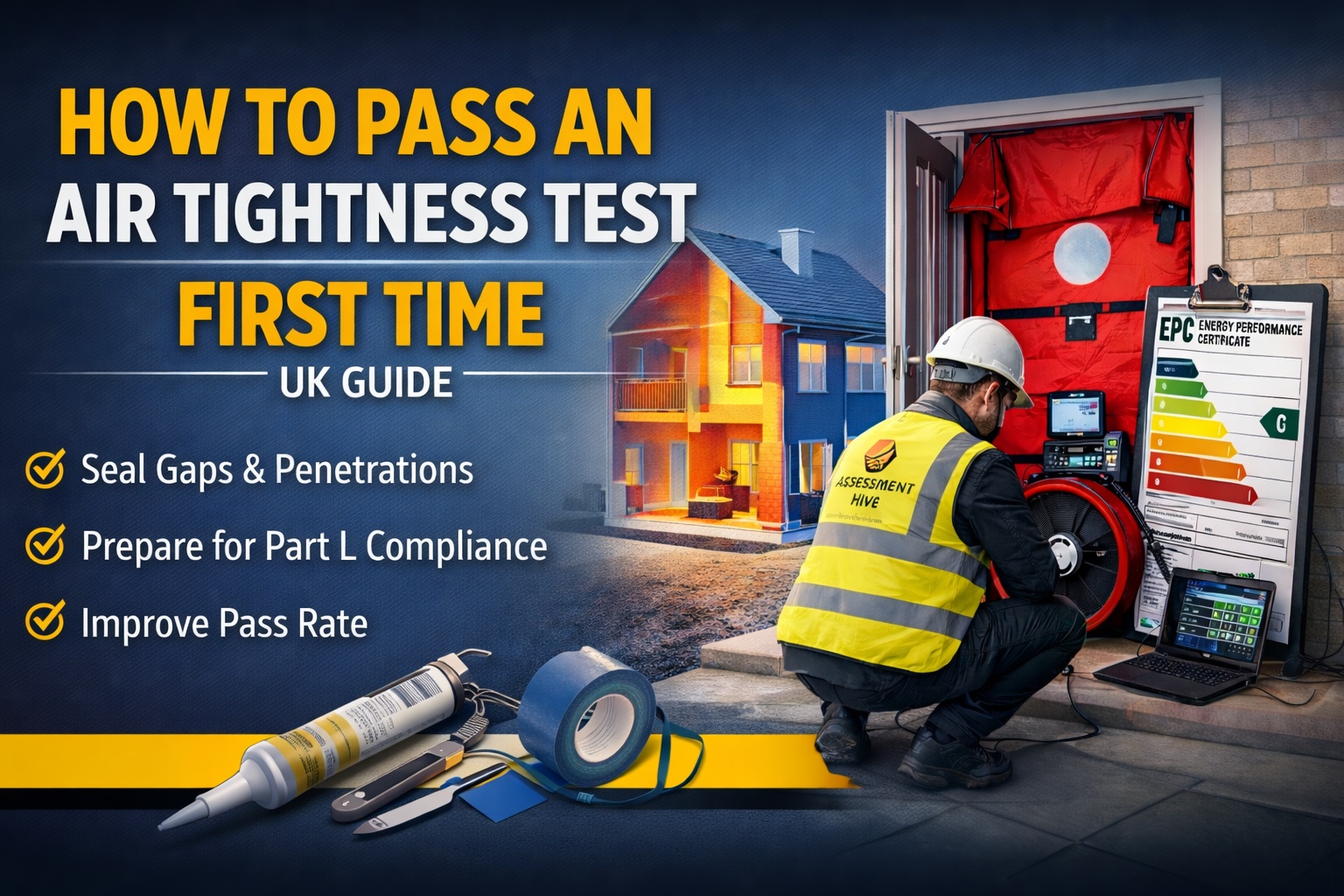
How to Pass an Air Tightness Test First Time (UK Guide)
Passing an air tightness test first time keeps your project on track. Otherwise, you risk delays, additional costs, and compliance issues under Building Regulations Part L.
However, most failures are avoidable. With the right preparation and coordination, you can pass first time and avoid unnecessary stress.
In this guide, we explain exactly how to prepare, what to check, and how to maximise your chances of success.
🔎 What Is an Air Tightness Test?
An air tightness test, also known as an air pressure test or blower door test, measures how much air leaks out of a building.
During the test, a technician installs a calibrated fan into an external doorway. Then, the system depressurises the building and measures airflow through gaps in the structure.
As a result, the test produces an air permeability score.
This result directly affects your SAP Calculations, which determine whether your building meets energy efficiency standards. Likewise, commercial projects rely on SBEM Calculations, while planning applications often require an Energy Statement. In addition, ventilation strategies within an Overheating Assessment can depend on airtightness levels.
Therefore, passing your test is essential for compliance.
⚠ Why Do Air Tightness Tests Fail?
First, you need to understand why tests fail. In most cases, poor site detailing causes the problem rather than design.
For example, common issues include:
- Gaps around pipes and cables
- Poor sealing around windows and doors
- Unsealed loft hatches
- Incomplete plastering
- Gaps behind skirting boards
Even small gaps can significantly affect your result. Therefore, attention to detail is critical at every stage.
🧱 How to Pass Your Air Tightness Test First Time
Now let’s focus on what actually works.
✔ 1. Seal All Service Penetrations
First and foremost, seal every penetration properly.
This includes:
- Pipes
- Electrical cables
- Ventilation ducts
If you leave gaps around these areas, air will escape quickly. Therefore, always use airtight tapes, grommets, or sealants to close them fully.
✔ 2. Check Windows and Doors Carefully
Next, inspect all windows and doors thoroughly.
Make sure:
- Frames are fully sealed
- Expanding foam fills all gaps
- No visible openings remain
In addition, check thresholds and corners, as these areas often get overlooked.
✔ 3. Seal Loft Hatches and Ceiling Voids
Loft areas frequently cause problems. Therefore, you must address them early.
Ensure:
- The hatch fits tightly
- Seals or gaskets are installed
- Surrounding gaps are sealed
Otherwise, warm air will escape into the roof space and reduce your performance.
✔ 4. Complete All Plastering
Before testing, complete all plastering work.
If walls remain unfinished, air will pass through joints and blockwork. Consequently, your result will worsen.
Therefore, always finish:
- Internal plastering
- Junction sealing
- Visible gaps
✔ 5. Close and Seal Ventilation Openings
Before the test begins, prepare ventilation correctly.
For example:
- Close trickle vents
- Temporarily seal extract fans
- Address any open flues
However, always follow your tester’s guidance to ensure compliance.
✔ 6. Carry Out a Pre-Test Inspection
Before testing, walk through the property carefully.
Look for:
- Drafts
- Visible gaps
- Incomplete finishes
In many cases, this simple step prevents failure. Therefore, never skip it.
✔ 7. Coordinate with Your SAP Assessor
Finally, align your build with your SAP Calculations.
If your design assumes a strong airtightness target, your construction must achieve it. Otherwise, the final result may exceed the allowed limit.
In addition, airtightness can influence overheating risk. Therefore, coordination with your Overheating Assessment ensures consistency across the project.
🏗️ When Should You Carry Out the Test?
Timing plays a key role in success.
You should test when:
- The building is fully sealed
- External elements are complete
- Internal finishes are nearly finished
However, avoid leaving testing too late. If issues arise, you need time to fix them.
🧠 Pro Tips from Site Experience
To improve your chances further, follow these practical tips:
- Test early on large developments
- Use airtightness tapes during construction
- Avoid last-minute drilling
- Brief all trades on airtightness requirements
- Keep a checklist on site
As a result, you will reduce risk and improve consistency.
🔗 How Air Tightness Fits Into Compliance
Air tightness does not work in isolation. Instead, it connects directly to other compliance requirements.
For example:
- It affects SAP Calculations for residential buildings
- It influences SBEM Calculations for commercial projects
- It supports assumptions in Energy Statements
- It impacts ventilation and overheating risk
Therefore, a coordinated approach improves overall performance and reduces delays.
If you need a full overview of the testing process, requirements, and costs, it helps to understand how everything fits together. In particular, air tightness plays a central role in overall compliance under Part L and links closely with SAP and other energy assessments. You can learn more about the full process on our Air Tightness testing UK page, where we explain how testing works, when it’s required, and how it impacts your project.
⚠ What Happens If You Fail?
If you fail the test, you must act quickly.
First, identify all leakage areas. Then, carry out repairs and seal gaps. Finally, arrange a retest.
Unfortunately, this process increases both cost and programme time. Therefore, passing first time should always be your goal.
❓ Frequently Asked Questions
What is a good air tightness result?
Most residential properties aim for 5 m³/h/m² or lower, depending on the design.
How long does the test take?
Typically, 1–2 hours for a standard property.
Can issues be fixed on the same day?
Minor issues can sometimes be resolved quickly. However, retesting is usually required.
Does airtightness affect EPC ratings?
Yes. Better airtightness improves energy efficiency and EPC performance.
🏆 Final Thoughts
Ultimately, passing your air tightness test first time comes down to preparation, attention to detail, and coordination.
If you seal gaps properly, check key areas, and align your build with your compliance strategy, you will significantly reduce the risk of failure.
Most importantly, treat airtightness as part of a bigger system. When you align it with SAP, SBEM, and planning requirements, your project will run far more smoothly.
📞 Need Help Passing First Time?
At Assessment Hive, we support clients before, during, and after testing to maximise pass rates.
Whether you need air tightness testing, SAP Calculations, or wider compliance support, we provide a fast and reliable service across the UK.
Get in touch today and make sure your project passes first time.
 Quick turnaround Local qualified assessors Clear, actionable reports Fixed, affordable pricing
 Call us on 020 7183 3240
 Email us at [email protected]
 Request Instant Quote → Click Here