MEES 2031 Changes: EPC B Proposals for Commercial Landlords Explained
The Government has announced a major change to the future Minimum Energy Efficiency Standards (MEES) for non-domestic privately rented properties in England and Wales.
On 18 June 2026, the Government confirmed its intention to introduce a more targeted approach to improving the energy efficiency of commercial rented buildings.
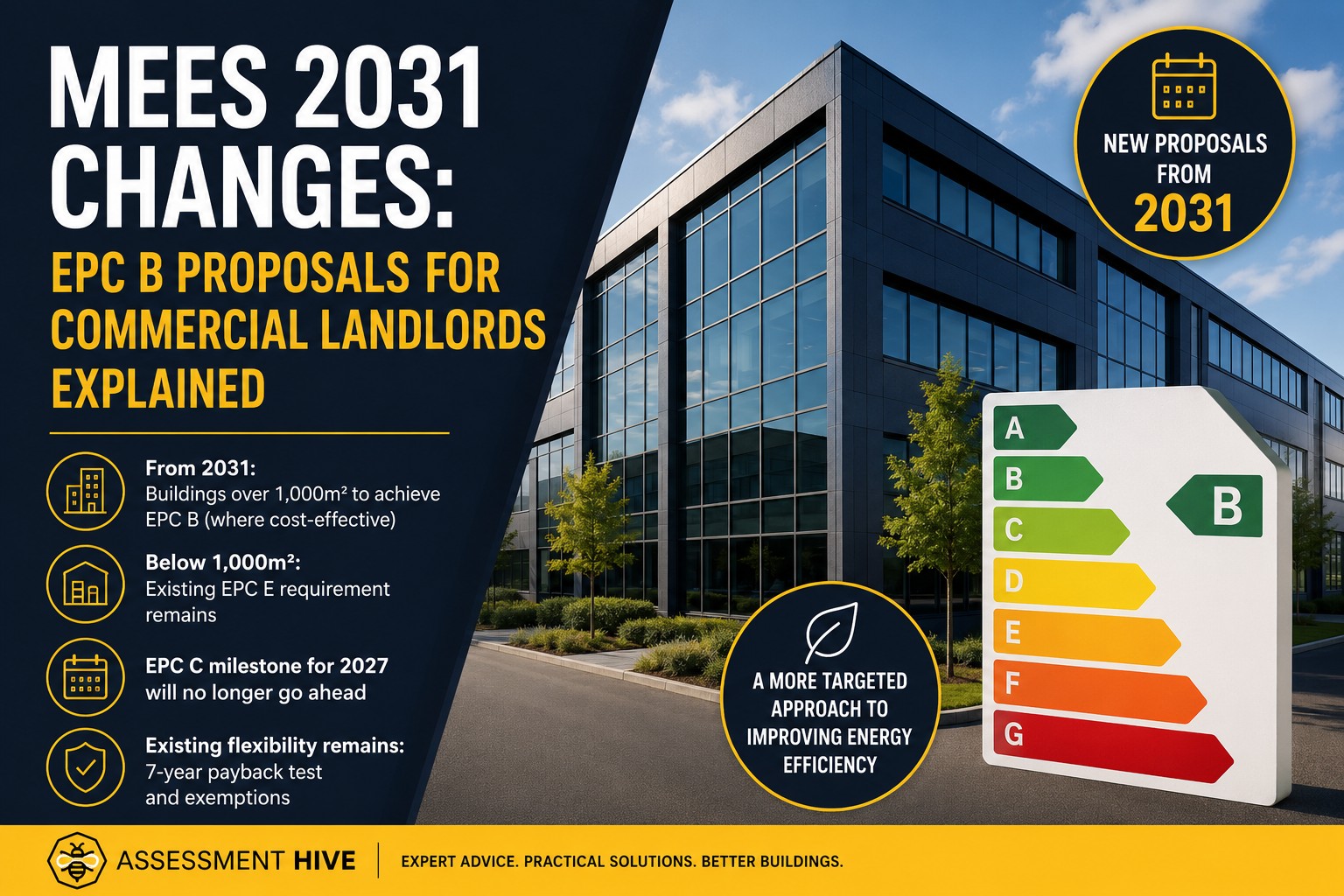
Under the proposed MEES 2031 changes, privately rented non-domestic buildings over 1,000m² will be expected to achieve an EPC rating of B from 2031, where this is cost-effective.
Meanwhile, buildings below 1,000m² are intended to remain subject to the existing minimum EPC E standard.
Importantly, the previously proposed EPC C milestone for 2027 will no longer go ahead.
However, the new EPC B requirement is not yet in force. Secondary legislation must successfully pass through Parliament before the requirement takes effect.
In this guide, we explain what has changed, which commercial properties could be affected and what landlords should consider doing now.
🏢 What Are the New MEES 2031 Proposals?
The Government’s new approach focuses the higher energy efficiency requirement on larger commercial buildings.
Under the proposed changes:
Non-domestic privately rented buildings over 1,000m²
These properties are expected to need a minimum EPC rating of B from 2031, where achieving that standard is cost-effective.
Non-domestic privately rented buildings below 1,000m²
These properties are intended to remain subject to the existing minimum EPC E requirement.
The previously proposed interim requirement for properties to achieve EPC C by 2027 will not be taken forward.
This represents a significant change to the direction of MEES policy.
If you’re unfamiliar with how the current regulations work, read our MEES Compliance Services guide for an overview of MEES and the existing requirements.
📅 When Will the New MEES Rules Come Into Force?
The proposed higher standard is intended to apply from 2031.
However, it is important to understand that the EPC B requirement is not yet law.
The Government has confirmed its intention to introduce the new approach, but secondary legislation must successfully pass through Parliament before the requirement takes effect.
The Government has also said that further information will be provided regarding the policy and how the 1,000m² threshold will be implemented.
Therefore, landlords should continue to monitor developments as the legislation progresses.
You can read the UK Parliament Written Ministerial Statement of 18 June 2026 for the Government’s announcement.
📐 Which Commercial Properties Could Need EPC B by 2031?
Under the proposed approach, the EPC B requirement will focus on privately rented non-domestic buildings over 1,000m² in England and Wales.
This could include larger:
- Offices
- Retail premises
- Warehouses
- Industrial units
- Commercial developments
- Mixed commercial premises
- Other qualifying non-domestic rented buildings
The Government has stated that further details about how the 1,000m² threshold will be implemented will follow.
Therefore, landlords should avoid making assumptions about whether a particular property will fall within the future requirement until the detailed legislation and guidance are available.
If you are unsure of your building’s current energy performance, a Commercial EPC assessment can establish its existing rating and provide an important starting point for planning towards future MEES requirements.
🏬 What Happens to Commercial Buildings Below 1,000m²?
One of the most significant elements of the announcement concerns smaller commercial properties.
Under the Government’s proposed approach, privately rented non-domestic buildings below 1,000m² will remain subject to the existing minimum EPC E standard.
Therefore, the proposed EPC B requirement will not currently extend across the entire non-domestic private rented sector.
This is a substantial change from the previous direction of policy.
However, landlords of smaller commercial buildings must still comply with the existing MEES requirements.
If you’re unsure whether your property currently complies, our MEES Compliance Services for Landlords explains how we review an existing EPC, identify potential compliance issues and develop a practical improvement strategy.
❌ Has the EPC C Requirement for 2027 Been Scrapped?
Yes.
The Government has confirmed that the previously proposed EPC C milestone for 2027 will not be taken forward.
Previously, proposals had considered moving commercial properties towards EPC B through an interim EPC C milestone.
That approach has now changed.
Instead, the Government intends to focus on achieving EPC B from 2031 for privately rented non-domestic buildings over 1,000m², where cost-effective.
For commercial landlords who had been planning improvements around the previous EPC C proposal, this makes it particularly important to review their strategy before committing to further expenditure.
💷 What Does “Where Cost-Effective” Mean?
The words “where cost-effective” are extremely important.
The proposed EPC B requirement does not necessarily mean landlords will have to carry out every possible energy efficiency improvement regardless of cost.
The Government has confirmed its intention to retain existing flexibility mechanisms, including the seven-year payback test and MEES exemptions.
These mechanisms help ensure that improvement requirements remain practical and financially proportionate.
Therefore, determining MEES compliance can involve considerably more than simply looking at the recommendations on an EPC.
🧾 Will MEES Exemptions Still Apply?
Yes. The Government has stated that the existing flexibility mechanisms will remain in place.
Depending on the property and circumstances, an exemption may be relevant where certain improvements cannot reasonably or cost-effectively be undertaken.
However, landlords should not automatically assume that their property qualifies.
MEES exemptions have specific requirements and appropriate evidence may be necessary.
We’ve created a separate guide explaining the different exemptions, when they may apply and what landlords should consider.
👉 Read our complete guide to MEES Exemptions for Landlords.
⚠️ Don’t Carry Out Improvements Before Understanding What You Actually Need
This is perhaps the most important advice we can give commercial landlords following the announcement.
Do not automatically start carrying out expensive improvement works simply because your existing EPC is below B.
An EPC includes recommendations for improving a property’s energy efficiency. However, that does not necessarily mean every recommendation should be implemented.
For example, one improvement could be expensive while having relatively little effect on the final EPC rating.
Alternatively, a different combination of improvements may achieve the required result at a considerably lower cost.
Furthermore, the seven-year payback test or an exemption could potentially be relevant depending on the circumstances.
Therefore, the first question shouldn’t be:
“What improvements can I install?”
It should be:
“What is the most cost-effective route to achieving the EPC rating I actually need?”
🔍 Get Expert Advice Before Spending Money
Before committing to significant improvement works for MEES compliance, we recommend having the property reviewed by an experienced energy professional.
A detailed assessment can help establish:
- The property’s existing EPC position
- Why the property currently achieves its particular rating
- Which elements are having the greatest impact
- Which improvements could increase the rating
- The likely impact of different improvement measures
- Whether EPC B appears achievable
- Which combination of measures may be most cost-effective
- Whether the seven-year payback test could be relevant
- Whether a MEES exemption may need investigating
This is particularly important with larger commercial buildings, where improvement works can involve significant expenditure.
At Assessment Hive, our approach is to understand the building first and recommend improvements second.
Our MEES Compliance Services for Landlords explains the process we use to help landlords develop a practical route towards compliance.
📊 What Should Commercial Landlords Do Now?
Although 2031 may appear some distance away, owners of larger commercial buildings should consider starting their planning early.
That does not necessarily mean carrying out improvement works immediately.
Instead, it means understanding where your property currently stands.
1️⃣ Check Your Existing EPC
Start by establishing the property’s current EPC rating.
Properties already achieving EPC A or B may be well positioned for the proposed requirements.
However, buildings rated C, D or E may benefit from further investigation.
If your property needs a new certificate, our guide to Commercial EPC costs explains what affects the price of assessing a non-domestic building and what information can help you obtain an accurate quotation.
2️⃣ Review the Current Recommendations
Your EPC provides recommendations that can help identify possible improvements.
However, treat these as a starting point rather than automatically using them as a schedule of works.
3️⃣ Understand What Is Affecting the EPC Rating
A commercial EPC can be influenced by several elements of the building, including:
- Heating
- Cooling
- Ventilation
- Lighting
- Building fabric
- Glazing
- Hot water systems
- Controls
- Renewable technologies
Understanding which elements are affecting the rating can help focus attention on the measures likely to produce the greatest benefit.
4️⃣ Investigate Different Improvement Scenarios
Rather than automatically installing the most expensive technologies, consider modelling different improvement options.
The objective should be to find the most practical and cost-effective combination of measures.
For further general guidance, see our article on how to improve your EPC rating.
5️⃣ Consider Whether an Exemption Could Apply
Where improvements are particularly expensive or unsuitable, investigate whether the existing MEES flexibility mechanisms could be relevant.
6️⃣ Create a Long-Term MEES Strategy
If improvements are likely to be required, consider whether they can be incorporated into planned:
- Refurbishment works
- Heating or cooling replacement
- Lighting upgrades
- Tenant fit-outs
- Maintenance programmes
- Building fabric improvements
Planning ahead could allow improvements to be completed at a more appropriate time rather than rushing to comply as the deadline approaches.
💡 Why Early MEES Planning Could Save Landlords Money
The biggest benefit of acting early isn’t necessarily completing the works early.
It is having time to make better decisions.
Imagine a commercial landlord discovers in 2030 that a large building requires substantial upgrades to reach EPC B.
With limited time remaining, the landlord may feel pressured into carrying out expensive works quickly.
Now compare this with a landlord who investigates the property several years earlier.
They may be able to coordinate EPC improvements with:
- A planned boiler or HVAC replacement
- Lighting upgrades
- Refurbishment
- Lease events
- Tenant fit-outs
- Planned maintenance
That can potentially reduce disruption and avoid duplicating expenditure.
Therefore, early planning is not simply about compliance.
It can be a financial strategy.
📈 How Can You Improve a Commercial EPC Rating?
There isn’t one improvement that works for every commercial property.
The best strategy depends on the building, its services, construction and existing EPC performance.
Potential improvements could include:
- More efficient lighting
- Improved heating and cooling systems
- Better controls
- Improved insulation
- More efficient glazing
- Renewable technologies
- Improvements to hot water systems
However, this is exactly why landlords should avoid assuming that every improvement is necessary.
Our guide on how to improve your EPC rating provides more information about common energy efficiency improvements.
🐝 How Assessment Hive Can Help With MEES 2031
At Assessment Hive, we help landlords and property professionals understand their energy efficiency obligations and identify practical routes towards compliance.
Our approach isn’t simply to produce a list of expensive improvements.
Instead, we can review the property and investigate the options before you commit to unnecessary expenditure.
Our MEES service can help with:
- Reviewing the existing EPC
- Assessing the property’s current MEES position
- Identifying why the building achieves its current rating
- Investigating potential improvement measures
- Assessing different improvement scenarios
- Identifying a practical route towards the required standard
- Considering relevant cost-effectiveness requirements
- Identifying where further investigation of an exemption may be appropriate
The aim is simple:
Understand what your property actually needs before spending money on improvements.
❓ Frequently Asked Questions About the MEES 2031 Changes
🏢 What EPC rating will commercial landlords need by 2031?
The Government intends for privately rented non-domestic buildings over 1,000m² in England and Wales to achieve an EPC B from 2031, where cost-effective.
📐 Do commercial properties below 1,000m² need EPC B?
Under the Government’s announced approach, buildings below 1,000m² are intended to remain subject to the existing EPC E minimum standard.
📅 Is EPC B by 2031 already law?
No. The Government has announced its intended approach, but the new requirement will require the successful passage of secondary legislation through Parliament before taking effect.
❌ Is the EPC C requirement for 2027 still happening?
No. The Government has confirmed that the previously proposed EPC C milestone for 2027 will not be taken forward.
💷 What does “where cost-effective” mean for MEES?
Existing flexibility mechanisms are intended to remain, including the seven-year payback test. Therefore, the regulations recognise that improvements need to be financially proportionate.
🧾 Will MEES exemptions still apply after the changes?
The Government has stated that existing flexibility mechanisms and exemptions will remain. However, landlords will need to satisfy the applicable requirements for an exemption.
Read our complete guide to MEES exemptions for more information.
⚠️ Should I start improving my commercial property now?
Not necessarily.
If your building could be affected by the 2031 requirement, the first step should be understanding its current EPC performance and investigating what improvements may actually be required.
Avoid committing to expensive works solely because the existing EPC is below B without first understanding the most appropriate route.
🔍 Can Assessment Hive tell me what improvements I need?
Assessment Hive can review your property’s energy performance and investigate potential improvement scenarios to help identify a practical route towards MEES compliance.
🏬 Does MEES only apply to new tenancies?
Landlords should consider the current MEES requirements whenever they rent qualifying properties. If you’re unsure about the relationship between EPCs and letting a property, read our guide: Can You Rent a Property Without an EPC?.
💰 How much does an EPC assessment cost?
The price depends on factors such as property type, size, location and complexity. Commercial properties generally cost more to assess than standard residential properties.
📞 Need Help Preparing for MEES 2031?
If you own or manage a commercial property over 1,000m², now is a good time to understand where your building stands.
That doesn’t necessarily mean carrying out improvements today.
Instead, it means developing a clear plan before committing to potentially expensive works.
Assessment Hive can review your existing EPC, investigate potential improvements and help you understand the most practical route forward.
👉 Speak to Assessment Hive about our MEES Compliance Service today.
-
 Fast turnaround
 -
 Competitive pricing
 -
 Remote, nationwide service
 Call us on 020 7183 3240
 Email us at [email protected]
 Request Instant Quote → Click Here
📝 Important Note
The Government announced its intended approach to the future non-domestic MEES requirements on 18 June 2026.
The proposed EPC B requirement for privately rented non-domestic buildings over 1,000m² is subject to the successful passage of secondary legislation through Parliament.
Further details about the policy and implementation of the 1,000m² threshold are expected.
Assessment Hive will update this guide as further legislation and Government guidance are published.