MEES Exemptions Explained – A Complete Guide for Landlords
If your rental property does not meet the required Minimum Energy Efficiency Standards (MEES), you may be wondering whether you need to carry out improvements or whether your property could qualify for a MEES exemption.
In certain circumstances, landlords may be able to register an exemption rather than carry out specific energy-efficiency improvements. However, an exemption should never be assumed.
The type of property, recommended improvements, cost of the work and individual circumstances can all affect whether an exemption may apply.
Therefore, before spending significant amounts of money on improvements — or assuming that no work is required — it is important to understand your position.
In this guide, we explain the main MEES exemptions for landlords, how the exemption process works and why getting appropriate advice before making a decision can help you avoid unnecessary costs.
For a broader explanation of the regulations, visit our MEES Compliance Services guide.
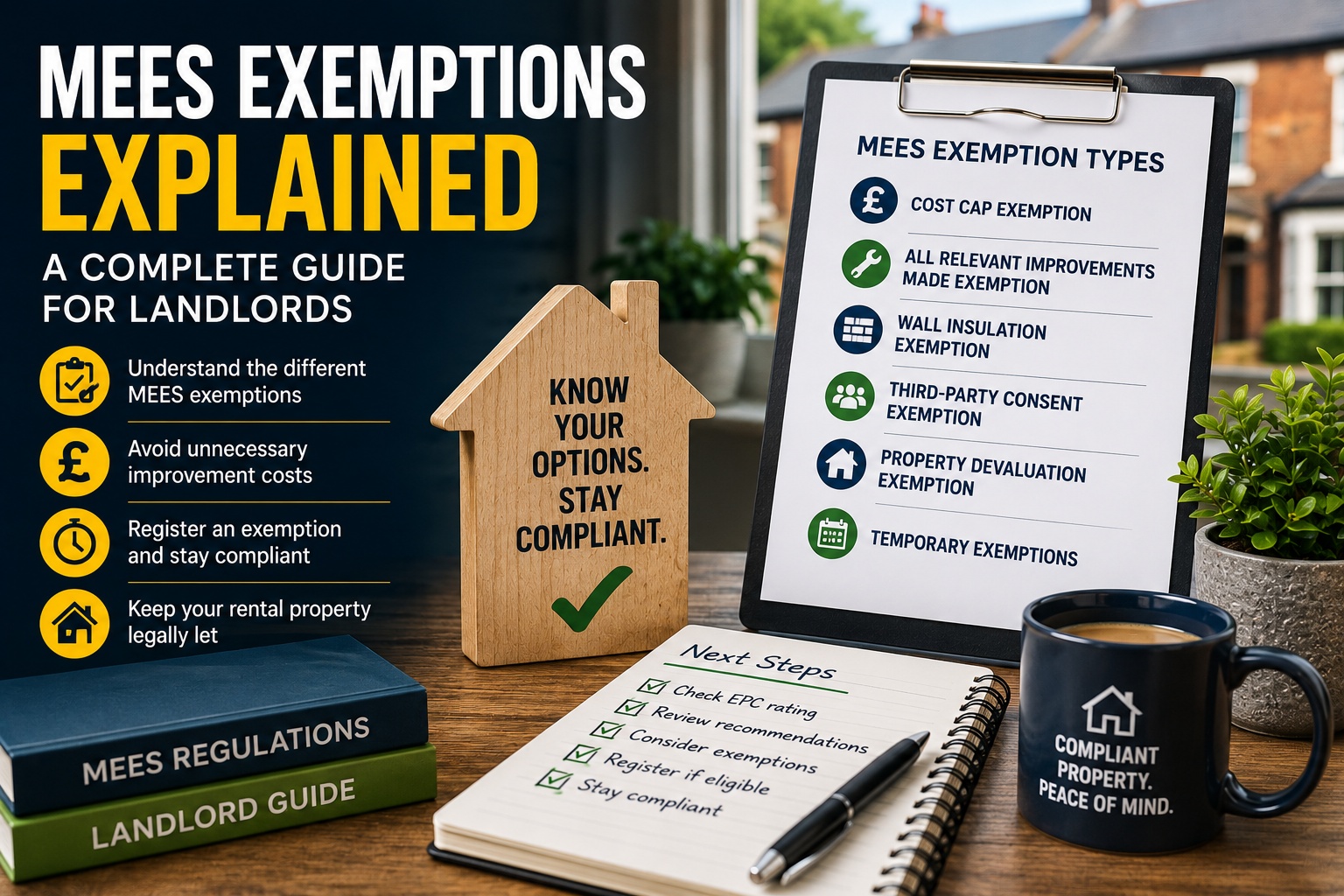
📘 What Is a MEES Exemption?
A MEES exemption allows a landlord to continue letting a property in certain circumstances even though it does not meet the minimum energy-efficiency standard that would otherwise apply.
However, simply believing that an improvement is too expensive, unsuitable or impractical does not automatically exempt a property.
The landlord must normally meet the relevant exemption criteria and register the exemption with the appropriate evidence.
This distinction is important.
An exemption is not the same as ignoring the MEES requirements.
Landlords should establish:
- What EPC rating the property currently has
- Which MEES requirements apply
- Which improvements have been recommended
- Whether those improvements are required
- Whether an exemption is available
- What evidence is needed
If you are unsure about the minimum rating requirements themselves, our guide on what EPC rating landlords need in the UK is a useful starting point.
🏠 When Might a Landlord Need a MEES Exemption?
A landlord may consider an exemption when a property falls below the applicable MEES standard but there is a legitimate reason why one or more qualifying improvements cannot reasonably be completed.
Depending on the circumstances and the applicable regulations, this might involve issues such as:
- The cost of improvements
- Technical suitability
- Required third-party consent
- Potential impact on property value
- Specific wall-insulation considerations
- A temporary exemption following certain changes in landlord circumstances
However, different exemption rules can apply to domestic and non-domestic property.
Therefore, landlords should avoid assuming that an exemption they have heard about automatically applies to their building.
💷 What Is the MEES Cost Cap?
For domestic private rented properties in England and Wales, MEES rules include a financial threshold relating to the cost of relevant energy-efficiency improvements.
Where applicable, landlords are expected to invest up to the relevant cost cap in qualifying improvements before relying on a cost-based exemption.
This means that a landlord cannot necessarily avoid improvement works simply because they involve expenditure.
Instead, you need to establish which measures are relevant, how much they are expected to cost and how the regulations apply to the particular property.
Where the appropriate improvements cannot bring the property up to the required standard within the applicable cost rules, an exemption may potentially be available.
Evidence is important.
Therefore, landlords should retain suitable records of quotations, recommendations, assessments and any works completed.
🔧 What Is the ‘All Relevant Improvements Made’ Exemption?
Sometimes a landlord may complete all the relevant energy-efficiency improvements that can reasonably be made, but the property still does not achieve the required EPC rating.
In these circumstances, an all relevant improvements made exemption may potentially apply.
For example, a landlord might complete the relevant qualifying measures but the property could remain below the minimum standard because of its construction, age or other limitations.
The important point is that the landlord must be able to demonstrate that the relevant improvements have been considered and, where required, completed.
You should not simply assume that because a property is difficult to improve, it qualifies automatically.
🧱 Is There a Wall Insulation Exemption?
Wall insulation can present particular challenges in some properties.
This is especially relevant to buildings with construction types where cavity wall, external wall or internal wall insulation could potentially have unintended consequences.
In certain circumstances, an exemption may be available where the installation of a relevant wall-insulation system could negatively affect the fabric or structure of the property.
However, this requires appropriate professional evidence.
For example, evidence may need to come from a suitably qualified or relevant professional who can demonstrate why the proposed insulation is not appropriate.
This is particularly important for older and traditionally constructed properties, where installing unsuitable insulation without properly understanding the building could create moisture or building-fabric problems.
Therefore, you should seek suitable professional advice before making substantial changes to the building fabric.
🤝 What Is the Third-Party Consent Exemption?
Some energy-efficiency improvements cannot be completed without permission from another person or organisation.
Depending on the property, consent could potentially be required from:
- A tenant
- A freeholder
- A superior landlord
- A mortgage lender
- A planning authority
- Another relevant third party
If the necessary consent is refused, or granted subject to conditions that prevent the work from reasonably proceeding, an exemption may potentially apply.
However, landlords should be able to demonstrate that they made reasonable efforts to obtain the required consent.
Simply deciding not to request permission is not the same as having permission refused.
Keep records of correspondence and supporting documents because they may be required when registering or demonstrating the exemption.
📉 What Is the MEES Property Devaluation Exemption?
In some circumstances, a landlord may be able to claim an exemption if carrying out a particular energy-efficiency improvement would reduce the property’s market value by more than the threshold specified by the regulations.
This is sometimes referred to as the devaluation exemption.
However, landlords cannot simply estimate the potential reduction themselves.
Suitable evidence is required, normally involving an assessment by an appropriately qualified independent professional.
As a result, this exemption is likely to apply only in relatively specific circumstances.
If you are considering relying on a devaluation exemption, professional advice should be obtained before making a decision.
⏳ Are Temporary MEES Exemptions Available?
Certain circumstances can provide landlords with temporary protection from immediate MEES requirements.
For example, specific situations involving a person becoming a landlord may provide a limited period in which to bring the property into compliance.
These provisions are designed to give landlords a reasonable opportunity to assess the property and take the necessary action.
However, temporary exemptions should not be treated as permanent solutions.
Once the relevant period ends, the landlord will normally need to establish compliance or determine whether another valid exemption applies.
📝 How Do You Register a MEES Exemption?
Where a domestic MEES exemption applies, landlords generally need to register it on the PRS Exemptions Register.
The information required will depend on the exemption being claimed.
Evidence could include:
- EPC information
- Improvement recommendations
- Contractor quotations
- Evidence of completed work
- Professional reports
- Valuation evidence
- Correspondence showing attempts to obtain consent
- Other supporting documents
It is important to provide accurate information.
Registering an exemption does not remove the need to meet the relevant eligibility criteria.
Therefore, landlords should establish that the exemption genuinely applies before submitting it.
📅 How Long Does a MEES Exemption Last?
MEES exemptions are generally time-limited.
Many exemptions last for a defined period rather than remaining with the property indefinitely.
In addition, exemptions do not simply transfer permanently between landlords.
Therefore, buying a property that previously benefited from an exemption does not necessarily mean the new owner can rely on the same position indefinitely.
This makes record keeping particularly important for landlords managing multiple rental properties.
You should know:
- Which properties have exemptions
- Which exemption applies
- When it was registered
- When it expires
- What action may be required before expiry
A property portfolio can otherwise develop compliance problems simply because an exemption expiry date was overlooked.
⚠️ What Happens When a MEES Exemption Expires?
When an exemption expires, the landlord should reassess the property against the rules that apply at that time.
This may mean obtaining updated information and considering whether improvements that were previously unsuitable or uneconomic are now viable.
Technology, installation costs and the property itself may all have changed.
For example, a measure that was not appropriate several years ago may become a realistic option later.
Therefore, exemption expiry dates should form part of your ongoing property compliance management rather than being treated as a one-off administrative task.
👷 Get Advice Before Carrying Out Improvements or Claiming an Exemption
This is one of the most important points for landlords.
If your property has a poor EPC rating, there are two expensive mistakes you want to avoid:
1. Carrying out improvements you did not need.
2. Assuming you qualify for an exemption when you do not.
For example, you could spend thousands of pounds replacing windows, changing heating systems or installing insulation when another combination of improvements may achieve the required result more efficiently.
Equally, assuming that a property is exempt because improvements appear expensive could leave you exposed to compliance problems.
Therefore, before committing to substantial expenditure, consider obtaining appropriate professional advice.
An expert can review the EPC, property and proposed improvements and help establish the appropriate next steps.
Our MEES Compliance Services are designed to help landlords understand their compliance position before making potentially expensive decisions.
📈 Could Improving the EPC Be Better Than Claiming an Exemption?
Potentially.
An exemption may solve an immediate compliance issue where the qualifying conditions genuinely apply. However, improving the energy performance of the property can provide longer-term benefits.
These may include:
- Better energy efficiency
- Reduced energy consumption
- Improved tenant comfort
- A more attractive rental property
- Better preparation for future energy-efficiency requirements
Therefore, it is worth comparing the available options before deciding that an exemption is the best route.
Our guide on how to improve your EPC rating explains the main upgrades landlords can consider and why getting advice before undertaking the work is important.
⚖️ How Do MEES Exemptions Relate to EPC Ratings?
An EPC and a MEES exemption serve different purposes.
The EPC establishes the energy performance rating of the property.
MEES regulations then determine whether that rating meets the relevant standard for the property to be let.
If it does not, the landlord may need to carry out relevant improvements or establish whether an exemption applies.
Therefore, obtaining an EPC alone does not necessarily establish MEES compliance.
Likewise, registering an exemption does not change the EPC rating itself.
If you are preparing to let a non-domestic property, our guide to EPC requirements when selling or renting commercial property explains how Commercial EPC requirements and MEES interact during a property transaction.
Understanding this difference helps landlords make better compliance decisions.
🚫 Can You Rent a Property With an EPC F or G If You Have an Exemption?
A valid exemption may allow a property that would otherwise fall below the applicable MEES standard to continue to be let, provided the relevant regulatory requirements have been satisfied.
However, the exemption must genuinely apply and be properly registered where required.
Landlords should therefore avoid treating exemptions as a general workaround for poorly performing properties.
For a broader explanation of EPC requirements when letting a property, read our guide: Can You Rent a Property Without an EPC?
🏢 Are Commercial MEES Exemptions Different?
Yes. This is an important distinction.
Non-domestic MEES regulations apply to commercial properties such as:
- Offices
- Shops
- Warehouses
- Industrial units
- Other qualifying non-domestic rented buildings
Although commercial MEES also provides for exemptions in certain circumstances, landlords should not assume the domestic cost-cap rules and exemption procedures apply in exactly the same way to commercial property.
The assessment methodology is also different.
Domestic properties generally use a Residential EPC, whereas non-domestic buildings require a Commercial EPC.
Commercial developments and certain building works may also involve SBEM Calculations.
Therefore, if you own commercial property, the compliance strategy should be considered specifically against the non-domestic MEES requirements.
🏘️ Do Listed Buildings Automatically Have a MEES Exemption?
No — landlords should be careful with this assumption.
The interaction between EPC requirements, listed buildings and MEES can be more complicated than simply saying that every listed property is exempt.
The building’s circumstances, EPC requirements and the effect of potential energy-efficiency measures all need to be considered.
For example, some improvements may affect the character or appearance of a listed building and require consent.
However, that does not automatically mean every energy-efficiency improvement is impossible.
Therefore, landlords with listed or historic properties should obtain appropriate advice before assuming the property falls outside the requirements.
💷 How Much Does a MEES Exemption Cost?
There is not necessarily one fixed ‘MEES exemption cost’.
Instead, landlords may incur costs while obtaining the evidence required to establish whether an exemption applies.
Depending on the circumstances, these could include:
- EPC assessment costs
- Contractor quotations
- Specialist reports
- Professional advice
- Valuation reports
- Building surveys
However, these costs can be worthwhile if they prevent unnecessary improvement works or establish the correct compliance route.
If you need to obtain or renew the property’s EPC first, our guide on how much an EPC costs in the UK explains what affects the price of an assessment.
🐝 How Assessment Hive Can Help With MEES Compliance
At Assessment Hive, we help landlords and property professionals understand the energy-performance requirements affecting their properties.
Rather than immediately spending money on improvements or assuming an exemption applies, we can help you establish the appropriate starting point.
Depending on your property, our services include:
- MEES Compliance Services
- Residential EPCs
- Commercial EPCs
- SAP Calculations
- SBEM Calculations
- Energy assessment support
Our aim is to help you understand what your property requires before unnecessary expenditure takes place.
If improvements are needed, establishing the right strategy first can help you prioritise the measures most relevant to your property.
If an exemption may be appropriate, you can then determine what evidence and further professional input may be required.
❓ Frequently Asked Questions About MEES Exemptions
What is a MEES exemption?
A MEES exemption may allow a landlord to continue letting a property that does not meet the applicable minimum energy-efficiency standard where specific regulatory criteria are satisfied.
Do I automatically qualify for an exemption if my EPC is F or G?
No. A low EPC rating does not automatically create an exemption. You must establish whether one of the relevant exemption criteria applies.
Do I need to register a MEES exemption?
Where registration is required, the exemption must be entered on the appropriate PRS Exemptions Register with the necessary supporting evidence.
How long does a MEES exemption last?
It depends on the exemption. Many are time-limited, so landlords should keep accurate records and monitor expiry dates.
Does a MEES exemption transfer when a property is sold?
Landlords should not assume that an existing exemption automatically provides the same protection to a new owner. The new landlord should establish their own compliance position.
Can I claim an exemption because improvements are too expensive?
Not simply because you consider the improvements expensive. The relevant MEES rules and, where applicable, cost criteria must be satisfied.
Can a listed building be exempt from MEES?
Potentially, depending on the circumstances, but listed status should not automatically be treated as a blanket MEES exemption. Appropriate advice should be obtained.
Can I claim an exemption if a freeholder refuses permission?
A third-party consent exemption may potentially apply where required consent cannot be obtained, provided the relevant conditions and evidence requirements are satisfied.
Should I improve the property instead of claiming an exemption?
That depends on the property, cost of improvements, expected EPC improvement and the reason an exemption may apply. Professional advice can help you compare the options before spending money.
Are MEES exemptions the same for residential and commercial properties?
No. Domestic and non-domestic MEES have different rules and should be considered separately.
📞 Need Help With MEES Compliance?
If your rental property has a low EPC rating, don’t assume you need to carry out every recommended improvement — and don’t assume you automatically qualify for an exemption.
Establishing the correct position first could help you avoid unnecessary expenditure and compliance problems.
Assessment Hive can help you understand your property’s EPC and MEES position and determine the appropriate next steps.
 Fast turnaround (24–48 hours) Competitive pricing Fully accredited assessments Friendly, expert guidance
 Call us on 020 7183 3240
 Email us at [email protected]
 Request Instant Quote → Click Here
Whether you require a Residential EPC, Commercial EPC or support with MEES compliance, contact Assessment Hive today to discuss your property before making expensive energy-efficiency improvements.