DER vs TER Explained – What They Mean for SAP Compliance
If you are working on a new dwelling, you will encounter two critical SAP outputs: DER and TER.
Understanding DER vs TER is essential because these values determine whether your project passes or fails Part L compliance.
Put simply:
-
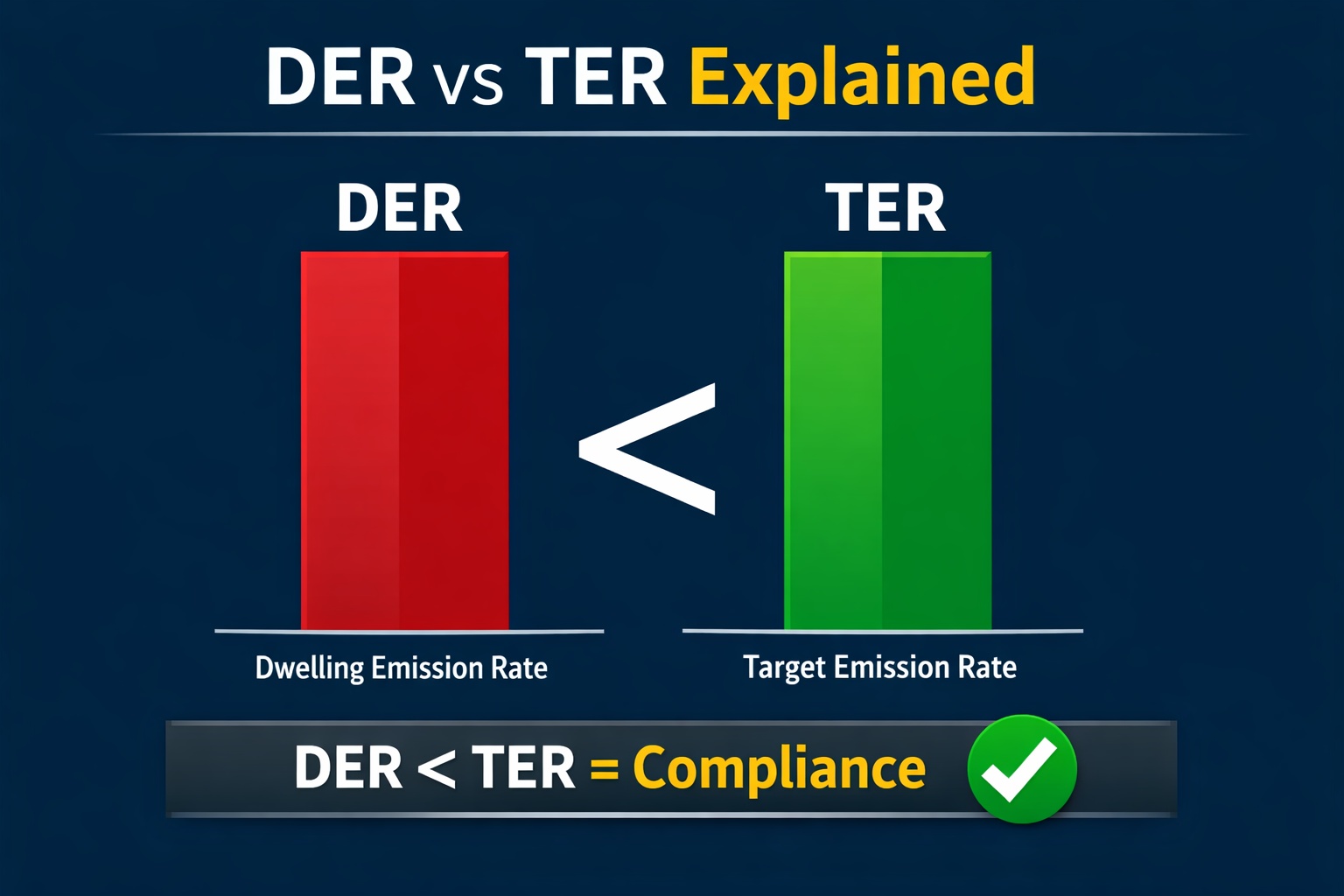
DER = Dwelling Emission Rate
-
TER = Target Emission Rate
To comply with Building Regulations, your DER must be lower than your TER.
In this guide, we explain what DER and TER actually mean, how SAP calculates them, and what you can do if your dwelling fails.
For a complete overview of the SAP framework, start with our guide to SAP Calculations UK. For London-specific compliance considerations, see SAP Calculations London.
🧮 What Is DER (Dwelling Emission Rate)?
DER represents the predicted carbon emissions from your proposed dwelling.
Specifically, SAP calculates DER based on:
-
Insulation performance (U-values)
-
Thermal bridging
-
Airtightness
-
Heating system efficiency
-
Hot water systems
-
Ventilation strategy
-
Renewable technologies
SAP expresses DER in kgCO₂/m² per year.
In other words, DER tells Building Control how much carbon your dwelling is expected to emit annually.
Because DER reflects your actual design specification, small changes in insulation, glazing or heating systems can significantly affect the result.
Emission calculations are based on SAP 10 assumptions. For more detail, read SAP 10 Explained.
🎯 What Is TER (Target Emission Rate)?
TER represents the maximum carbon emissions your dwelling is allowed to produce under Building Regulations Part L.
Unlike DER, SAP does not calculate TER from your specific design choices. Instead, it generates TER using a notional dwelling model that meets regulatory standards.
This notional building:
-
Uses defined insulation levels
-
Assumes standardised heating efficiency
-
Follows regulated fabric targets
Therefore, TER acts as a benchmark.
Your design must outperform that benchmark.
⚖️ DER vs TER – The Simple Rule
Compliance follows one clear rule:
If DER is lower than TER → You pass.
If DER is higher than TER → You fail.
However, passing by a very small margin can still create risk. For example, if your design only narrowly beats TER, a slightly worse air test result could push DER above the target.
Consequently, building a comfortable compliance buffer is often wise.
If you want to understand how to strengthen performance margins, read how to improve your SAP score before submission.
🏗️ How SAP Calculates DER and TER
SAP calculates DER using your actual specification inputs. It then calculates TER using the regulatory notional building.
The software compares:
-
Predicted carbon emissions (DER)
-
Permitted emissions benchmark (TER)
Because DER reflects your real design, any change in insulation thickness, glazing area or heating efficiency can alter the outcome.
For example:
-
Increasing insulation lowers DER
-
Improving heating efficiency lowers DER
-
Reducing air permeability lowers DER
-
Adding solar PV lowers DER
Therefore, small adjustments can make the difference between passing and failing.
🚫 What Happens If DER Exceeds TER?
When DER exceeds TER, your dwelling fails Part L compliance.
In that situation, you must revise the design before Building Control approval.
Common corrective measures include:
-
Increasing insulation thickness
-
Upgrading glazing performance
-
Reducing air permeability targets
-
Selecting higher efficiency heating systems
-
Adding renewable energy systems
However, late-stage changes can disrupt construction and increase cost. For that reason, early modelling is critical.
Thermal bridging directly increases DER. Learn more in Thermal Bridging in SAP Calculations.
Air leakage increases heating demand and raises DER. See How Air Tightness Impacts SAP Calculations for a detailed explanation.
🌬️ The Role of Airtightness in DER Results
Air permeability significantly affects DER.
If your final air test result exceeds the assumed design-stage value, DER will increase. In some cases, this can push the dwelling from passing to failing.
Therefore, coordinate early with Air Tightness Testing providers and set realistic targets.
Overly optimistic assumptions often cause last-minute compliance issues.
🧱 Fabric First vs Renewables – What Lowers DER Most?
Many developers assume renewables solve everything. However, a strong fabric-first strategy often provides more stable compliance.
For example:
-
Better insulation reduces heat loss permanently
-
Improved thermal bridging details strengthen performance
-
Airtightness improvements reduce heating demand
Reducing heat loss through a fabric-first approach is one of the most effective ways to lower DER. See Fabric First Strategy in SAP Calculations.
Renewables, such as solar PV, can then provide additional margin.
Balancing fabric performance and system efficiency is usually the most cost-effective strategy.
🏠 DER vs TER for New Builds
All new dwellings must demonstrate DER < TER.
Therefore, if you are building a house or block of flats, SAP Calculations for New Builds must show compliance before construction proceeds.
Design-stage modelling confirms this. Subsequently, as-built SAP verifies final installation details and the actual air test result.
If you are working on a new dwelling, see SAP Calculations for New Builds for full guidance.
🏢 What About Conversions?
Conversions also require DER vs TER comparison because they create new dwellings.
However, existing building constraints can make compliance more complex.
For conversion-specific guidance, read SAP Calculations for Conversions.
📉 Why Projects Fail DER vs TER
Projects usually fail for predictable reasons:
-
High glazing ratios
-
Weak insulation specifications
-
Poor airtightness
-
Inefficient heating systems
-
Late specification changes
Often, failure occurs because teams leave SAP too late.
To understand common submission errors, review What Happens if you Fail SAP Calculations and why Building Control reject SAP reports.
💷 Does Improving DER Increase Cost?
Not always.
Although higher specifications may increase upfront cost, late redesign typically costs more.
Furthermore, better fabric performance often reduces long-term energy bills, which can increase property value and buyer appeal.
If you are budgeting for compliance, read how much SAP Calculations cost in the UK.
✅ Quick Summary: DER vs TER Explained
-
DER = Your dwelling’s predicted carbon emissions
-
TER = Regulatory carbon benchmark
-
DER must be lower than TER to pass
-
Airtightness and insulation heavily influence DER
-
Early modelling prevents late redesign
📌 Final Thoughts
Understanding DER vs TER is fundamental to successful SAP compliance.
Rather than treating SAP as an afterthought, integrate modelling early in the design process. Doing so allows you to adjust fabric, glazing and heating systems before construction costs escalate.
If you need support reviewing your design, start with our main guide to SAP Calculations UK, or contact our team for project-specific advice.
-
 Fast turnaround
 -
 Competitive pricing
 -
 Remote, nationwide service
 Call us on 020 7183 3240
 Email us at [email protected]
 Request Instant Quote → Click Here