What Happens If You Fail SAP Calculations?
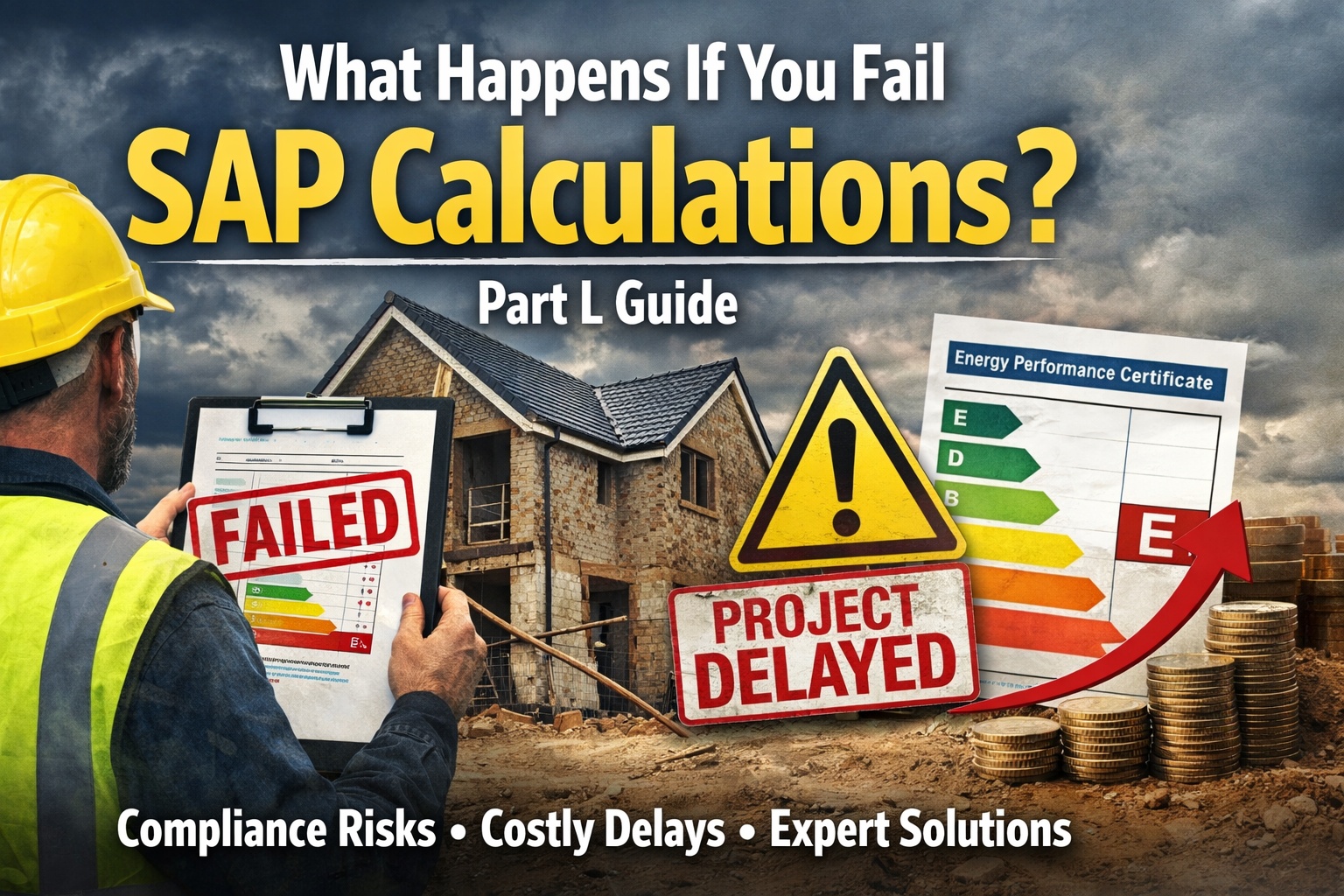
Failing SAP Calculations can delay your project, increase costs, and create unnecessary stress. However, in most cases, failure is both common and fixable—especially when identified early in the design stage.
If you are planning a new build, extension or conversion, understanding what happens when SAP compliance fails will help you avoid delays and keep your project moving.
In this guide, we explain why SAP failures occur, what steps follow, and how you can resolve issues quickly and efficiently.
For a full overview of compliance requirements, visit our SAP Calculations UK guide.
⚠ What Does It Mean to Fail SAP Calculations?
A SAP failure occurs when your proposed design does not meet the requirements of Building Regulations Part L.
For new builds, this usually means:
- Your Dwelling Emission Rate (DER) exceeds the Target Emission Rate (TER)
- Primary energy targets are not achieved
- Fabric Energy Efficiency (FEE) standards are not met
For conversions and extensions, failure typically relates to:
- Insufficient fabric upgrades
- Poor thermal performance
- Non-compliant glazing or heating systems
To understand compliance thresholds, read DER vs TER Explained.
🔍 Why Do SAP Calculations Fail?
Although every project differs, most SAP failures occur for predictable reasons.
1️⃣ Poor Fabric Performance
If insulation levels are too low, heat loss increases. As a result, energy demand rises and compliance becomes harder to achieve.
2️⃣ Excessive Glazing
Large glazed areas often increase heat loss. Consequently, projects with high glazing ratios frequently fail without compensating improvements.
3️⃣ Poor Air Tightness Assumptions
If air permeability targets are unrealistic, the final air test may exceed the design assumption. Therefore, compliance margins disappear.
Learn more in How Air Tightness Impacts SAP Calculations.
4️⃣ Thermal Bridging Issues
Poorly detailed junctions increase heat loss. In addition, inaccurate psi-values can significantly affect SAP results.
For further detail, read Thermal Bridging in SAP Calculations.
5️⃣ Inefficient Heating Systems
Outdated or poorly specified heating systems increase carbon emissions, which raises DER.
6️⃣ Late SAP Modelling
Perhaps the most common issue is leaving SAP too late. When modelling occurs after design decisions are fixed, resolving compliance becomes more difficult.
For more common issues, see Why Building Control Reject SAP Reports.
🛠 What Happens After a SAP Failure?
Although failing SAP can seem serious, the next steps are usually straightforward.
Step 1 – Review the SAP Report
First, your assessor identifies which elements caused the failure. Many compliance failures occur due to changes introduced under SAP 10. Our guide on SAP 10 Explained provides further insight.
Step 2 – Identify Weak Points
Next, the report highlights specific issues such as:
- High heat loss areas
- Inefficient systems
- Poor airtightness assumptions
Step 3 – Implement Improvements
Then, your assessor recommends practical changes to improve performance.
Step 4 – Re-run SAP Calculations
Once changes are applied, the SAP model is updated to confirm compliance.
Step 5 – Achieve Compliance
In most cases, modest adjustments resolve the issue without major redesign.
📈 How to Fix SAP Calculation Failures
Fortunately, most SAP failures can be resolved with targeted improvements.
✅ Improve Insulation
Increasing insulation levels reduces heat loss and improves performance. In many cases, improving insulation, airtightness and junction detailing resolves compliance issues. Learn more in Fabric First Strategy in SAP Calculations.
✅ Upgrade Glazing
Switching to higher-performance glazing reduces heat transfer.
✅ Improve Air Tightness
Sealing gaps and improving airtightness can significantly reduce heating demand.
✅ Reduce Thermal Bridging
Better junction detailing improves fabric performance.
✅ Upgrade Heating Systems
Modern, efficient systems can reduce emissions and improve SAP results.
✅ Add Renewable Technologies
Solar PV and heat pumps can offset carbon emissions and improve compliance margins.
For more strategies, read How to Improve Your SAP Score Before Submission.
🏗 SAP Failure in New Builds
For new builds, failure typically relates to DER exceeding TER.
Because compliance margins can be tight, early modelling is essential. Otherwise, changes later in construction become more expensive.
If you are planning a development, see SAP Calculations for New Builds.
🏢 SAP Failure in Conversions
Conversions often fail because existing buildings limit upgrade potential.
For example:
- Solid walls restrict insulation
- Structural constraints limit changes
- Airtightness is harder to achieve
Therefore, realistic modelling becomes critical.
For guidance, see SAP Calculations for Conversions.
🏡 SAP Failure in Extensions
Highly glazed extensions commonly fail due to increased heat loss.
However, improving glazing performance and insulation usually resolves compliance quickly.
If you are planning an extension, see SAP Calculations for Extensions.
🏙 SAP Failures in London Projects
London developments often operate under tighter compliance margins.
Because planning-stage Energy Statements may set strict carbon targets, SAP modelling must align with those commitments.
Failure to align planning and Building Regulations can delay approval.
For location-specific guidance, see SAP Calculations London.
🧠 How to Avoid SAP Failure
The best way to avoid failure is to act early.
- Engage a SAP assessor at design stage
- Confirm insulation and glazing specifications early
- Set realistic air tightness targets
- Coordinate with design and construction teams
- Align SAP with planning-stage Energy Statements
By taking these steps, you reduce risk and improve compliance certainty.
🧠 Final Thoughts
Failing SAP Calculations is not the end of your project.
In fact, most failures are part of the normal design process. When identified early, they provide an opportunity to improve performance before construction begins.
With the right guidance, you can:
- Resolve compliance issues quickly
- Avoid delays with Building Control
- Improve long-term energy performance
- Achieve stronger EPC ratings
❓ Frequently Asked Questions
Can you fail SAP Calculations after construction?
Yes. If the as-built SAP differs from the design-stage assumptions—particularly air tightness results—you may fail compliance at completion stage.
Is SAP failure common?
Yes. Many projects require minor adjustments before achieving compliance. Early modelling reduces this risk significantly.
How long does it take to fix a SAP failure?
In most cases, adjustments can be made and recalculated within a few days, depending on the complexity of the changes.
What is the most common reason for SAP failure?
The most common causes include poor insulation, high glazing ratios, and unrealistic air tightness assumptions.
Can renewable energy fix SAP failure?
Yes. Technologies such as solar PV and heat pumps often improve compliance margins and help achieve Part L targets.
Furthermore, we integrate SAP into your wider compliance strategy rather than treating it as a standalone report.
 Request a Quote for SAP Calculations
Planning a residential project in London?
Contact Assessment Hive today. We will review your drawings, assess compliance risk and provide a clear, fixed-fee proposal.
 Call us on 020 7183 3240
 Email us at [email protected]
 Request Instant Quote → Click Here