What Happens If You Fail SBEM Calculations?
If your project fails SBEM Calculations, your building does not meet the energy efficiency standards set out in Building Regulations Part L.
As a result, Building Control will not approve the design. However, failing SBEM is very common, and most projects require adjustments before they pass.
Therefore, understanding why SBEM failures happen — and how to fix them — will help you avoid delays, reduce costs, and keep your project on track.
For a full overview of how compliance works, read our guide on SBEM Calculations, which explains the process in detail.
📘 What Does “Failing SBEM” Mean?
SBEM modelling compares your building’s predicted emissions against a target emission rate.
In simple terms:
- ✔ Pass → Your building meets energy targets
- ❌ Fail → Your building exceeds allowed emissions
Consequently, the design team must improve the building specification before approval.
If your project is based in the capital, you should also review our guide on SBEM Calculations London, which explains how stricter policies can affect compliance.
🚨 Why Do SBEM Calculations Fail?
Several factors can cause a building to fail SBEM. Below are the most common reasons.
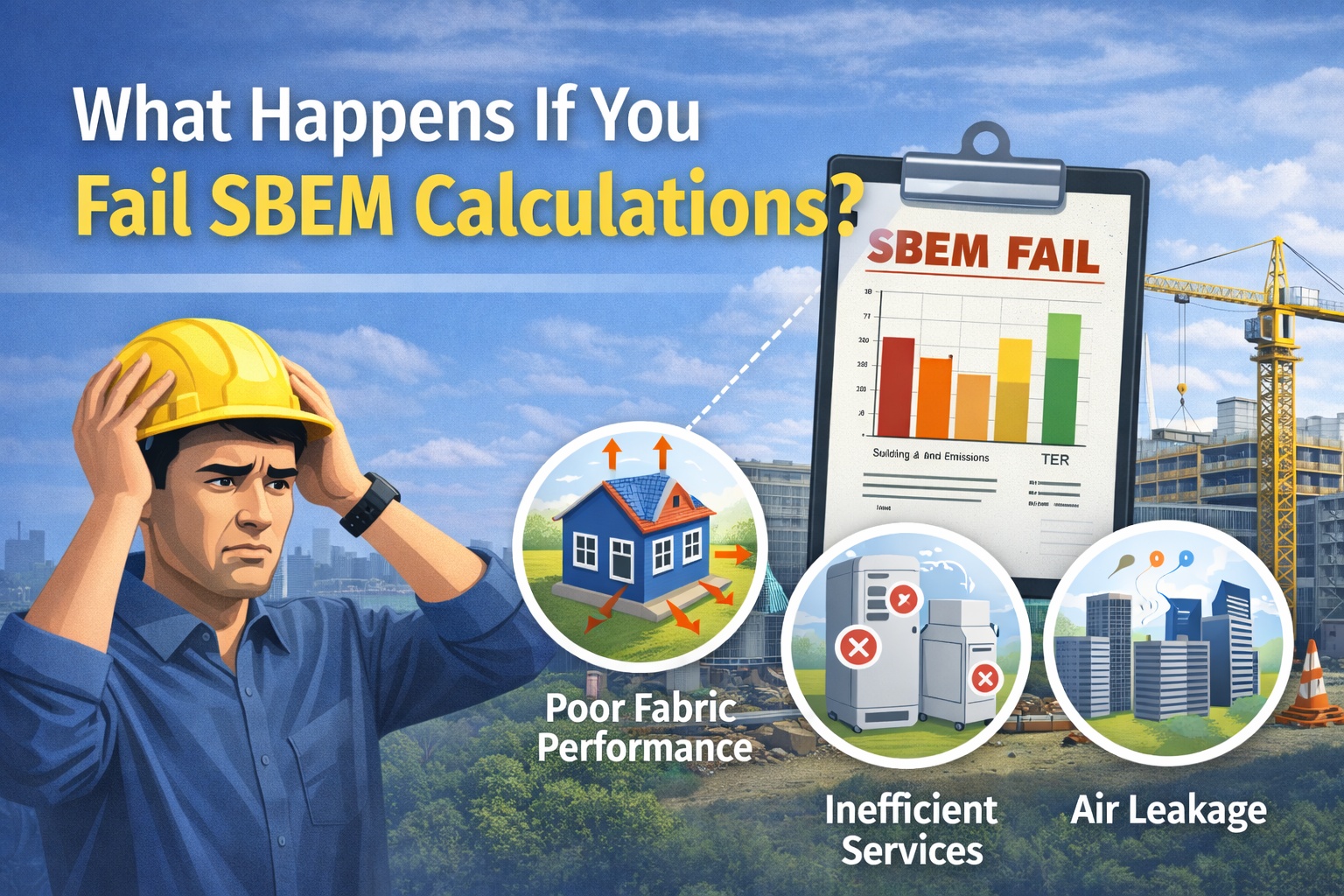
🧱 Poor Fabric Performance
Firstly, weak insulation increases heat loss.
Common issues include:
- High U-values
- Poor thermal bridging
- Inefficient glazing
As a result, the building requires more energy to maintain comfortable temperatures.
🪟 Excessive Glazing
Large glazing areas often reduce energy performance.
Although glazing improves natural light, it can increase heat loss and solar gain. Therefore, designers must balance aesthetics with efficiency.
🔥 Inefficient Building Services
Heating and cooling systems strongly influence SBEM results.
Failures often occur when:
- Systems are inefficient
- Controls are poorly designed
- Equipment is outdated
Consequently, energy consumption rises significantly.
💡 Poor Lighting Efficiency
Lighting also plays a key role.
For example:
- Inefficient lighting systems
- Lack of controls
- High lighting loads
These increase energy demand and reduce overall performance.
🌬 Air Leakage Issues
Air permeability assumptions directly affect SBEM outcomes.
If designers assume poor air tightness, energy performance drops. Therefore, improving air tightness targets can help achieve compliance.
🛠 How to Fix a Failed SBEM Calculation
The good news is that most failures can be resolved with targeted improvements.
🔧 Improve Fabric Efficiency
Start by upgrading insulation and construction details.
For example:
- Improve wall, roof and floor insulation
- Upgrade glazing performance
- Reduce thermal bridging
This often delivers the biggest improvement.
⚙ Upgrade Building Services
Next, improve system efficiency.
Options include:
- High-efficiency boilers or heat pumps
- Better ventilation systems
- Improved controls
These changes can significantly reduce emissions.
🌞 Add Renewable Energy
Renewable technologies can offset carbon emissions.
For example:
- Solar PV panels
- Heat pumps
- Low-carbon energy systems
As a result, overall emissions decrease.
🌬 Improve Air Tightness
Better air permeability improves performance.
Therefore, designers should:
- Set realistic air targets
- Improve detailing
- Coordinate construction quality
⚖ Optimise the Design
Finally, small design changes can have a big impact.
For example:
- Adjust glazing ratios
- Improve orientation
- Reduce energy demand
🏗 Can You Still Get Approval If You Fail SBEM?
No — you must fix the design before Building Control approval.
However, developers often identify issues early through SBEM Calculations, which allows them to refine the design before submission.
In addition, many projects — particularly in London — require supporting documentation such as Energy Statements. Therefore, early modelling helps strengthen both planning and compliance.
🧾 What Happens After You Fix SBEM?
Once the design meets compliance targets, the assessor will rerun the SBEM model.
If the building passes:
- The project can proceed
- Building Control can approve the design
- Compliance documentation is issued
Later, once construction finishes, an assessor produces a Commercial EPC using the SBEM model and final building data.
⏱ Will Failing SBEM Delay Your Project?
Yes — but only if you leave it too late.
If you carry out SBEM modelling early, you can:
- Identify issues quickly
- Make adjustments
- Avoid costly redesign
Therefore, early modelling is critical for smooth project delivery.
📍 SBEM Failures in London Developments
London developments often face stricter requirements due to policies influenced by the London Plan.
As a result:
- Energy targets are often higher
- Planning expectations are stricter
- Sustainability requirements increase
Therefore, developers should review SBEM Calculations early in the design process to avoid compliance issues.
❓ Frequently Asked Questions
Can a building fail SBEM and still be approved?
No. The design must pass SBEM before Building Control will approve the project.
Is failing SBEM common?
Yes. Many projects require adjustments before achieving compliance. Therefore, initial failure is normal.
How can I avoid failing SBEM?
You can avoid failure by carrying out SBEM modelling early and working with experienced assessors who can recommend design improvements.
🚀 Avoid SBEM Failure with Expert Support
At Assessment Hive, we help developers achieve compliance quickly and efficiently.
We provide:
- Fast SBEM modelling
- Clear recommendations
- Design optimisation support
- Full Part L compliance guidance
Contact Assessment Hive today to ensure your project meets energy requirements.
-
 Fast turnaround
 -
 Competitive pricing
 -
 Remote, nationwide service
 Call us on 020 7183 3240
 Email us at [email protected]
 Request Instant Quote → Click Here