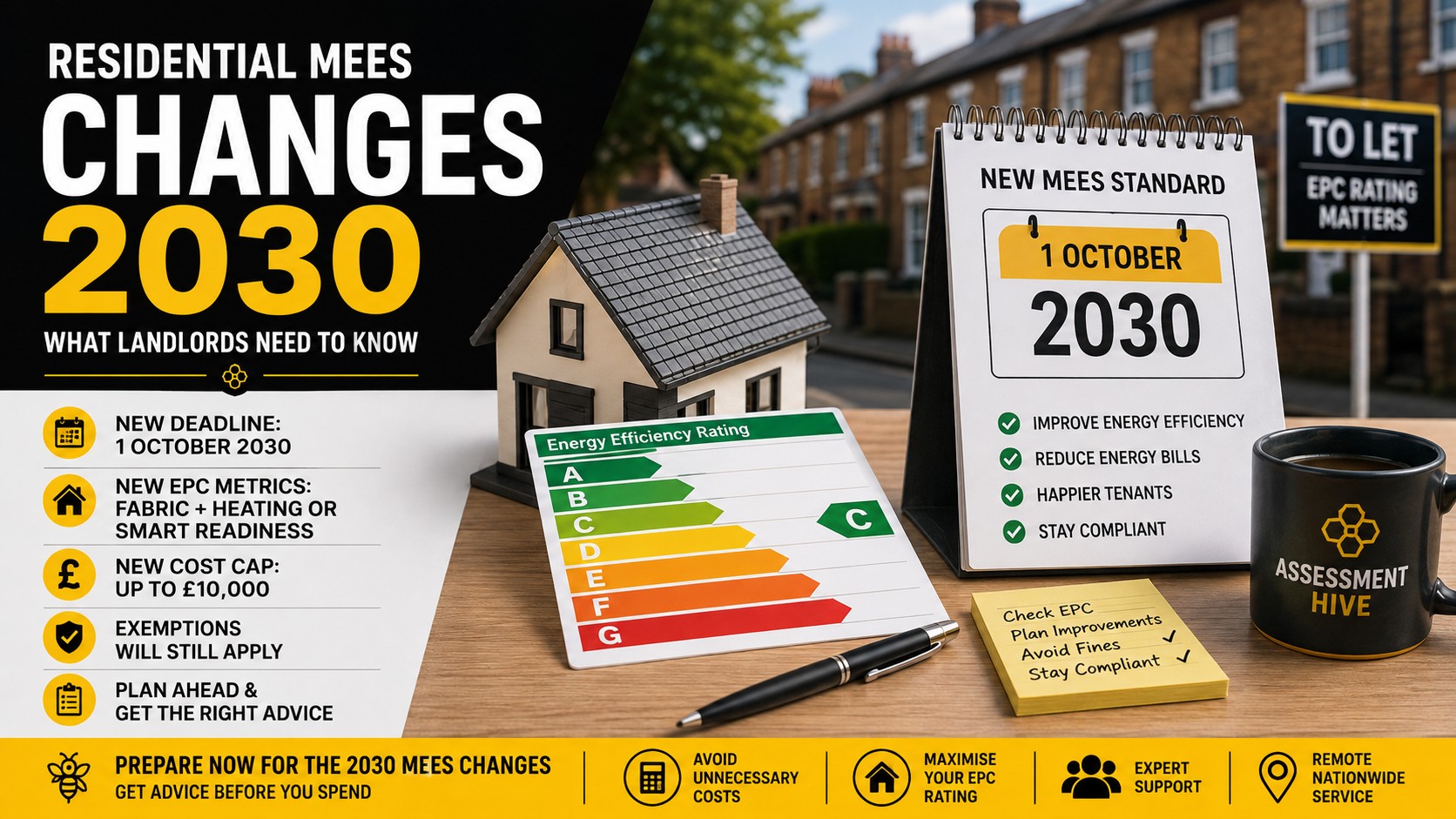
Residential MEES Changes 2030 – What Landlords Need to Know
Residential landlords face significant changes to the Minimum Energy Efficiency Standards (MEES) over the coming years.
In January 2026, the UK Government confirmed its intended approach for increasing energy-efficiency standards across the private rented sector. Under the plans, qualifying privately rented homes will need to meet a higher energy-efficiency standard by 1 October 2030, unless a valid exemption applies.
You may have seen these changes described as the requirement for rental properties to achieve EPC C by 2030.
However, the position is more complicated than simply moving every existing EPC to Band C.
The government intends to introduce reformed EPCs with new energy-performance metrics. Under the future MEES standard, landlords will need to meet a primary fabric performance standard, followed by either a heating system standard or smart readiness standard.
There will also be transitional arrangements for properties that achieve EPC C under the existing Energy Efficiency Rating before the new system takes effect.
Therefore, landlords should start preparing for 2030. However, that does not necessarily mean immediately carrying out every improvement currently listed on an EPC.
In this guide, we explain the residential MEES changes, the 2030 deadline, the proposed £10,000 cost cap and what landlords should consider before spending money on improvements.
If you’re new to the regulations, our complete MEES Compliance Services guide is a useful starting point. It explains how MEES works, who needs to comply and the relationship between EPC ratings and rental properties.
📢 What Are the Residential MEES Changes?
The government has confirmed its policy intention to increase the minimum energy-efficiency standard for privately rented homes in England and Wales.
Under the planned changes, qualifying private rented properties will need to comply with the higher standard by:
1 October 2030
This will apply to qualifying new and existing tenancies rather than introducing separate compliance dates depending on when the tenancy begins.
Until landlords become subject to the higher standard, the existing minimum standard continues to apply.
If you are unsure about today’s requirements, read our guide explaining what EPC rating landlords currently need in the UK before considering the future rules.
The important point is that the future system will not simply rely on the EPC methodology landlords are familiar with today.
Instead, the government intends to introduce new-style EPCs and use different performance metrics to determine compliance.
That makes planning ahead particularly important.
📅 When Will the New Residential MEES Rules Start?
The key date landlords need to remember is:
1 October 2030
By this date, qualifying private rented homes will need to meet the new higher standard or have a valid exemption.
The government intends to update the regulations before then. Therefore, landlords have time to understand their properties, consider potential improvements and plan expenditure.
However, leaving everything until 2030 could create problems.
A property may require:
- A new EPC assessment
- Professional energy advice
- Insulation improvements
- Heating improvements
- Building-fabric works
- Contractor quotations
- Installation work
- A post-improvement assessment
For landlords with multiple properties, the workload could be considerably greater.
Therefore, 2030 may sound distant, but portfolio planning should begin much earlier.
If you want to understand how a property moves from its initial EPC through potential improvements and towards compliance, our MEES compliance process guide explains the journey step by step.
🏠 Will Residential Landlords Need EPC C by 2030?
Broadly, EPC C or an equivalent higher standard is the government’s target for privately rented homes.
However, landlords need to understand what “or equivalent” means.
The future residential MEES standard is intended to use new EPC metrics rather than relying solely on the existing Energy Efficiency Rating.
The proposed approach consists of two stages.
First, the property must satisfy a:
Fabric Performance Standard
The landlord must then satisfy one of two secondary standards:
Heating System Standard
or
Smart Readiness Standard
Therefore, describing the future requirement simply as “EPC C” risks overlooking an important part of the new system.
The way a property achieves compliance will matter as much as the headline rating.
📊 How Will the New EPC System Work?
The government is reforming Energy Performance Certificates so they provide a broader picture of how a property performs.
Under the proposed residential MEES system, the new EPC metrics will influence which improvements landlords need to consider.
This is designed to move the system away from relying on one headline measure alone.
Instead, greater emphasis will be placed on areas such as:
- Building fabric
- Heating performance
- Smart energy management
- Overall energy efficiency
For landlords, this means future EPC information could become particularly important when planning improvements.
If your property does not achieve EPC C under the existing Energy Efficiency Rating before the transitional deadline, you are expected to need a new-style EPC before carrying out improvement works for the higher MEES standard.
This is one reason landlords should be cautious about making expensive assumptions today about precisely what their property will require in 2030.
🧱 What Is the Fabric Performance Standard?
Building fabric refers to the physical elements separating the inside of a property from the external environment.
These include:
- External walls
- Roofs
- Floors
- Windows
- Doors
- Insulation
A poorly performing building fabric allows more heat to escape. Consequently, more energy is needed to maintain comfortable internal temperatures.
The government’s planned approach puts fabric performance first.
Depending on the property, potential measures could include:
- Loft insulation
- Roof insulation
- Cavity wall insulation
- Solid wall insulation
- Floor insulation
- Improved glazing
- Draught reduction
However, the appropriate measures will vary considerably between buildings.
A modern cavity-wall house may require a completely different improvement strategy from a Victorian solid-wall property.
Therefore, landlords should avoid assuming the same solution applies to every rental property.
Our How to Improve Your EPC Rating guide looks at insulation, heating, windows, renewables and other potential improvements in more detail.
🔥 What Is the Heating System Standard?
Once the fabric requirement has been addressed, landlords will have a choice over the secondary metric.
One option will relate to the property’s heating system.
This is intended to consider the performance of the system used to heat the home.
Depending on how the final methodology operates, heating-related improvements could become increasingly important when landlords plan their route to compliance.
However, this does not mean landlords should immediately replace existing boilers or heating systems simply because the 2030 standard is approaching.
The correct strategy will depend on the building, its fabric, existing services and the final EPC assessment methodology.
This is particularly important because an expensive improvement is not necessarily the improvement that will deliver the best compliance outcome.
📱 What Does Smart Readiness Mean?
The alternative secondary route will be based on smart readiness.
In broad terms, smart technologies can help occupants understand, control and optimise their energy use.
This could potentially involve systems and controls that allow energy consumption to be managed more effectively.
The important point for landlords is that the government intends to provide a choice.
After satisfying the fabric performance requirement, a landlord will be able to choose between meeting the heating system metric or the smart readiness metric.
This flexibility could be valuable because different solutions will suit different properties.
🗓️ What If My Rental Property Already Has EPC C?
This is one of the most important transitional arrangements for landlords.
Private rented homes that achieve EPC C or above against the existing Energy Efficiency Rating before 1 October 2029 are intended to be recognised as compliant with the higher standard until that EPC expires or is replaced.
Therefore, landlords who have already improved their properties are not necessarily going to be forced immediately through the new assessment process in 2030.
This also creates an important strategic decision for landlords whose properties are currently close to EPC C.
Achieving EPC C under the existing methodology before the transitional cut-off could potentially provide a period of recognised compliance.
If you need to establish your property’s current rating, our Residential EPC service explains how the assessment works and how to arrange an EPC.
⏰ Why Is 1 October 2029 Important?
Although the main compliance date is 1 October 2030, there is another date landlords should have on their radar:
1 October 2029
Properties that achieve EPC C or above against the existing Energy Efficiency Rating on an EPC before this date can benefit from the transitional recognition described above.
The property can then be treated as meeting the higher standard until that EPC expires or is replaced.
Properties that have not achieved the relevant existing EPC C rating before the cut-off will need to follow the new system.
This is why landlords should not think of 2030 as the only important date.
💷 What Is the New £10,000 MEES Cost Cap?
Affordability has been one of the biggest concerns surrounding higher residential MEES standards.
The government’s policy sets the maximum required landlord investment at:
£10,000 per property
This applies to relevant energy-efficiency expenditure required to meet the new standard.
Importantly, £10,000 is a maximum required investment, not an automatic £10,000 bill for every landlord.
Some properties may require significantly less.
Others may still fail to reach the required standard after the landlord has invested up to the applicable limit.
Where the relevant conditions are met, an exemption may then be available.
Our MEES Exemptions Explained guide looks at cost-related exemptions and other circumstances where landlords may not be required to carry out particular improvements.
🧾 Can Energy Improvements Made Now Count Towards the £10,000?
Potentially, yes.
Under the government’s policy, relevant energy-efficiency expenditure dating from 1 October 2025 can count towards the first cost cap, subject to the rules governing eligible expenditure.
This is particularly important for landlords considering improvements before the new standard formally applies.
However, good record keeping will be essential.
Keep evidence such as:
- Invoices
- Receipts
- EPC recommendations
- Contractor quotations
- Installation information
- Relevant professional advice
These records may become important when demonstrating how much has already been invested in improving a property.
🏚️ What About Rental Properties Worth Less Than £100,000?
The government has recognised that a universal £10,000 maximum could disproportionately affect landlords of lower-value properties.
It therefore intends to introduce a Property Value Adjustment exemption for qualifying properties worth less than £100,000.
Under the policy, these properties would have a lower maximum spend requirement equivalent to 10% of the property’s value.
Therefore, a qualifying property valued at £80,000 could have a different maximum spending requirement from a property worth £250,000.
This provision is intended to make the regulations more proportionate.
As with other exemptions, landlords should establish the exact requirements rather than assuming the exemption automatically applies.
📑 Will MEES Exemptions Still Apply After 2030?
Yes. Exemptions are intended to remain an important part of the residential MEES system.
Where improvements cannot be installed or the relevant exemption criteria are satisfied, landlords may be able to register an exemption and continue letting the property for the applicable period.
However, exemptions should not be viewed as an easy alternative to compliance.
Landlords may need appropriate evidence, and exemptions can be time-limited.
⚠️ What Could the Penalties Be for Residential MEES Non-Compliance?
The government intends to strengthen enforcement significantly.
Its 2026 policy response proposes allowing local authorities to impose a maximum financial penalty of up to:
£30,000 per property, per breach
The necessary legal and regulatory changes are required before the future regime takes full effect.
Nevertheless, the proposed level of penalty demonstrates the government’s intended direction.
MEES compliance should therefore become part of normal landlord property management rather than something considered only when a tenancy changes.
For landlords who want to understand the current relationship between letting a property and EPC requirements, our guide Can You Rent a Property Without an EPC? explains the key considerations.
👷 Get Professional Advice Before Making EPC Improvements
This is one of the most important practical considerations for landlords preparing for the residential MEES changes.
Don’t ignore 2030 — but don’t blindly spend thousands of pounds either.
A landlord might look at an existing EPC and immediately consider:
- Replacing all the windows
- Installing external wall insulation
- Replacing the heating system
- Installing solar panels
- Upgrading heating controls
- Carrying out several smaller improvements
However, the future MEES regime will use reformed EPC metrics.
Furthermore, landlords who do not secure transitional EPC C recognition are expected to need a new-style EPC before carrying out the works required to meet the higher standard.
Therefore, spending significant amounts without understanding the property’s likely compliance route could result in unnecessary work.
Professional advice can help you establish:
- Your property’s current position
- Whether achieving existing EPC C may be realistic
- Which improvements may provide the greatest benefit
- Whether work should be carried out now or planned for later
- How expenditure should be documented
- Whether an exemption could potentially apply
The objective should be to achieve compliance as cost-effectively as possible — not simply to carry out every improvement listed on an EPC.
🔧 What Should Residential Landlords Do Now?
There is no need to wait until 2030 before considering your position.
However, that does not mean every landlord needs to begin major improvement work immediately.
A more sensible approach is to create a plan.
1. Check your existing EPC
Start by checking the property’s current EPC rating and expiry date.
If you do not have a valid certificate, our Residential EPC service can help you establish the property’s current energy performance.
2. Identify properties below EPC C
Properties currently rated D or E may deserve closer attention.
3. Prioritise the lowest-performing properties
An EPC D property close to C may present a very different challenge from an older EPC E property requiring several substantial improvements.
4. Get advice before spending money
Do not assume every recommendation on the existing EPC must be completed.
5. Keep records of relevant expenditure
Eligible improvements carried out from 1 October 2025 may potentially be relevant to the future cost cap.
6. Consider the 2029 transitional arrangements
Where appropriate, achieving EPC C against the existing Energy Efficiency Rating before 1 October 2029 could provide transitional recognition.
7. Monitor the EPC reforms
The new EPC methodology will be particularly important for landlords whose properties need to comply through the future metrics.
🏘️ What Should Portfolio Landlords Do?
If you own several rental properties, waiting until 2029 or 2030 could create a significant workload and capital requirement.
Instead, consider creating a simple MEES portfolio plan.
You could initially group properties according to their current EPC rating:
A–C EPC: Review EPC validity and monitor.
D EPC: Investigate potential improvement requirements.
E EPC: Prioritise for more detailed review.
F–G EPC: Establish the current MEES compliance position as a priority.
You can then consider the likely cost and complexity of improving each property.
This approach can help spread investment over several years rather than leaving multiple properties requiring attention close to the deadline.
💷 How Much Will Preparing for MEES 2030 Cost?
There is no single figure because every property is different.
Potential costs can include:
- EPC assessments
- Professional advice
- Insulation
- Heating improvements
- Glazing
- Controls
- Renewable technologies
- Other energy-efficiency measures
This is another reason why landlords should not automatically budget £10,000 for every property.
Some may require much less, while others could reach the applicable cost cap without achieving the future standard.
If you are budgeting for assessments, our guide to How Much Does an EPC Cost in the UK? explains typical EPC costs and what can affect the price.
🏡 Does This Affect Every Residential Rental Property?
The higher MEES standard is aimed at qualifying properties within the private rented sector in England and Wales.
However, not every residential building or letting arrangement is necessarily treated identically under energy-performance legislation.
Exclusions and exemptions can apply in certain circumstances.
Therefore, landlords with unusual properties, historic buildings or complex letting arrangements should establish whether the regulations apply before making significant investment decisions.
🔄 How Do the 2030 Changes Fit With Current MEES Rules?
It is important to separate the current MEES requirements from the future 2030 standard.
Landlords must continue to comply with the rules that apply today.
The future standard does not provide a reason to ignore an existing compliance problem.
Think of the process as two stages:
Now: Make sure your property complies with today’s requirements.
Next: Prepare strategically for the higher 2030 standard.
🐝 How Assessment Hive Can Help Landlords Prepare for MEES 2030
At Assessment Hive, we help landlords understand the energy performance of their properties and the assessments they may require.
Our services include:
- Residential EPCs
- MEES Compliance Services
- EPC improvement advice
- SAP Calculations for relevant residential projects
- Wider energy-assessment support
One of the most valuable times to seek advice is before you spend money.
If your property currently has an EPC D or E, for example, we can help you understand your starting position and appropriate next steps rather than assuming every EPC recommendation needs to be completed.
This can help landlords plan improvements more strategically and potentially avoid unnecessary expenditure.
❓ Residential MEES 2030 – Frequently Asked Questions
Will landlords need EPC C by 2030?
The government intends qualifying privately rented homes to meet EPC C or an equivalent higher standard by 1 October 2030, unless a valid exemption applies.
However, the future standard will use reformed EPC metrics rather than relying solely on today’s Energy Efficiency Rating.
When will the residential MEES changes start?
The planned single compliance date is 1 October 2030.
Is there an earlier deadline for new tenancies?
Under the government’s policy approach, qualifying new and existing tenancies will use the same 1 October 2030 compliance date.
What happens if my property already has EPC C?
A qualifying private rented home achieving EPC C or above against the existing Energy Efficiency Rating on an EPC before 1 October 2029 is intended to receive transitional recognition until that EPC expires or is replaced.
Will every landlord have to spend £10,000?
No.
£10,000 is the intended maximum required investment per property under the standard cost-cap arrangements. It is not a minimum amount landlords are expected to spend.
Can improvements I’m making now count?
Relevant qualifying energy-efficiency expenditure incurred from 1 October 2025 may potentially count towards the first cost cap under the government’s policy.
Landlords should retain suitable records of qualifying expenditure.
What if I reach the cost cap but still cannot achieve the standard?
Where the relevant conditions are met, a landlord may be able to register an exemption.
Our MEES Exemptions Explained guide provides a more detailed overview of how exemptions work.
Should I improve my EPC now or wait?
There is no single answer for every property.
Some landlords may benefit from acting earlier, particularly where achieving EPC C under the existing methodology is realistic.
Others may need to consider how the new EPC methodology affects their property before making substantial investment decisions.
Therefore, obtaining advice before carrying out expensive improvements can be valuable.
📞 Prepare Your Rental Property for the 2030 MEES Changes
The residential MEES changes represent a significant shift for private landlords.
However, preparing early does not mean spending money unnecessarily.
The first step is to understand your property’s existing EPC, the improvements that may be appropriate and how the transitional arrangements could affect you.
Assessment Hive can help you review your property’s energy-performance position and plan the appropriate next steps.
Whether you need a Residential EPC, advice on MEES compliance, or help understanding potential EPC improvements, contact Assessment Hive before committing to expensive energy-efficiency work.
Plan early. Improve strategically. Avoid unnecessary expenditure.
 Contact Assessment Hive today and ensure your property meets all legal requirements.
-
 Fast turnaround
 -
 Competitive pricing
 -
 Remote, nationwide service
 Call us on 020 7183 3240
 Email us at [email protected]
 Request Instant Quote → Click Here