What is a Commercial EPC? Complete UK Guide
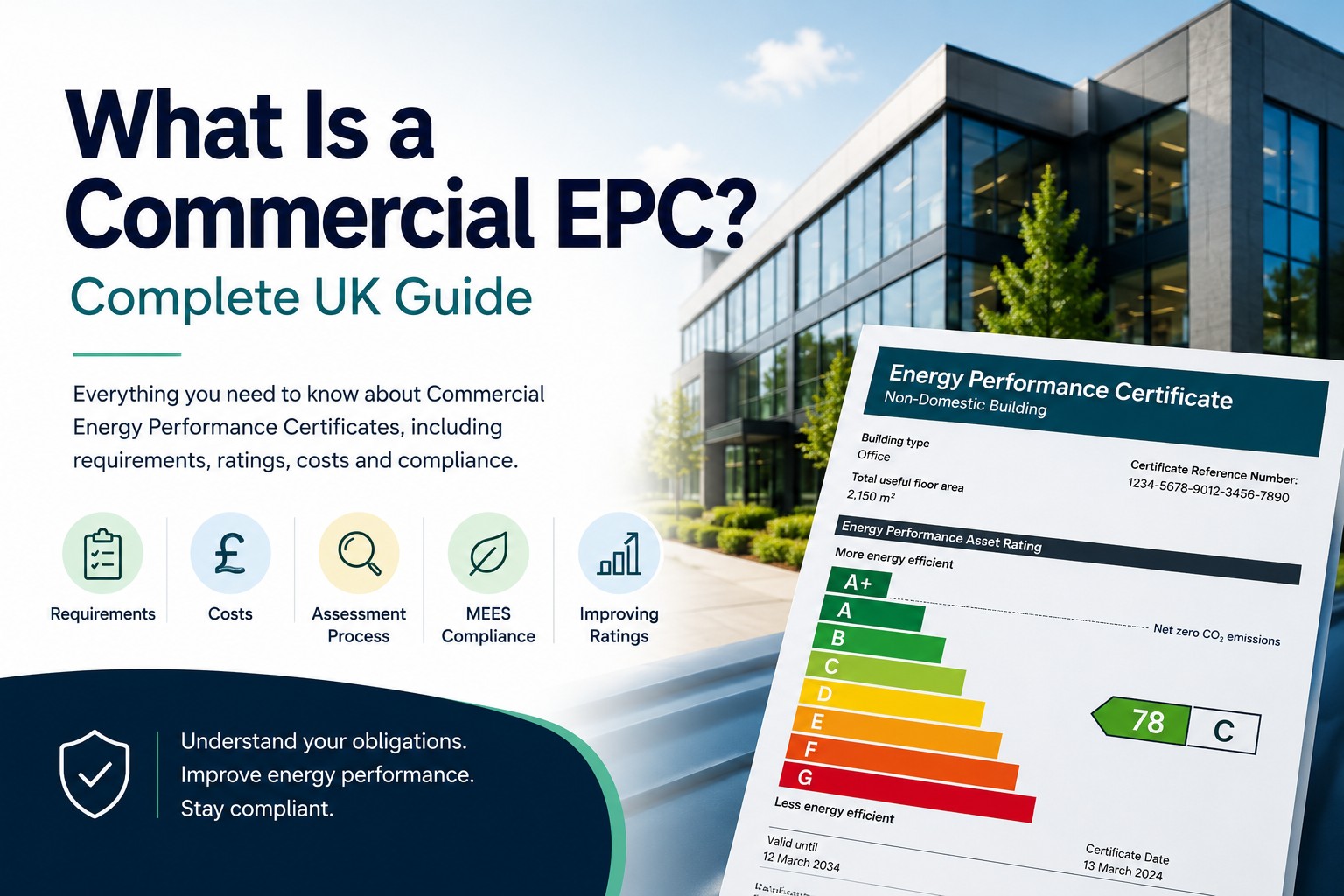
A Commercial Energy Performance Certificate (EPC) shows how energy efficient a non-domestic building is. If you own, sell, rent or manage commercial property, understanding EPC requirements can help you stay compliant and identify opportunities to improve the building’s energy performance.
In this guide, we explain what a Commercial EPC is, when you need one, how the assessment works, how much it costs and how EPC ratings connect with MEES and SBEM calculations.
🏢 What is a Commercial EPC?
A Commercial EPC, also known as a Non-Domestic Energy Performance Certificate, provides an energy efficiency rating for a commercial building.
The certificate gives the property a rating from A+ to G, with higher ratings representing better energy performance.
It also provides information about the building’s energy performance and recommendations for potential improvements.
It can apply to many types of property, including:
- Offices
- Shops and retail units
- Warehouses
- Industrial units
- Restaurants and cafés
- Hotels
- Healthcare premises
- Leisure facilities
- Mixed-use developments
- Other non-domestic buildings
If you already know that you require an assessment, visit our Commercial EPC services page to find out how Assessment Hive can help.
📊 What does it show?
A Commercial EPC gives property owners, landlords and prospective occupiers an indication of the building’s energy performance.
The certificate includes:
- The building’s current EPC rating
- Energy performance information
- Estimated energy use
- Carbon emissions information
- Recommendations for potential energy efficiency improvements
These recommendations can help identify areas where the building’s performance could potentially be improved.
However, the recommendations should not automatically be treated as a list of compulsory works. The suitability and cost-effectiveness of improvements will depend on the individual property.
📋 When is it required?
It is commonly required when a non-domestic building is:
- Constructed
- Sold
- Rented to a new tenant
Therefore, landlords and property owners should consider EPC requirements before marketing a commercial property.
There are circumstances where exemptions can apply, so the requirements should always be considered in relation to the specific building.
If you are preparing to sell or let commercial premises, read our guide explaining whether you need an EPC to sell or rent a commercial property.
🏡 Is a Commercial EPC Different From a Residential EPC?
Yes.
Although both certificates measure energy performance, residential and commercial properties use different assessment methodologies.
A Residential EPC is designed for domestic properties such as houses and flats.
A Commercial EPC applies to non-domestic buildings such as shops, offices, warehouses and industrial units.
Commercial buildings can contain significantly more complex heating, cooling, ventilation and lighting systems. Therefore, Commercial EPC assessments often require more detailed information.
If you need an assessment for a house or flat, visit our Residential EPC services page.
For an overview covering the different types of EPC available, visit our main EPC page.
🔍 What happens during an assessment?
During the assessment, a qualified Non-Domestic Energy Assessor collects information about the property and its building services.
Depending on the building, this can include:
- Building dimensions
- Walls, floors and roofs
- Windows and glazing
- Heating systems
- Cooling systems
- Ventilation
- Hot water
- Lighting
- Building controls
- Renewable technologies
The information is then entered into approved assessment software to calculate the property’s energy performance.
The complexity of this process can vary considerably between buildings.
For example, assessing a small shop with a simple heating system may be relatively straightforward. A large office containing multiple HVAC systems and different activity zones will normally require a more detailed assessment.
For a complete walkthrough, read our guide to what happens during an assessment.
📐 What Is the Difference Between Level 3 and Level 4 Commercial EPCs?
Commercial EPC assessments are not all the same.
Relatively simple commercial buildings can often be assessed at Level 3. However, buildings containing more complex services may require a Level 4 Non-Domestic Energy Assessor.
The appropriate assessment level depends on factors such as the building’s heating, cooling and ventilation systems.
It is therefore important to establish the correct assessment level before arranging your Commercial EPC.
Assessment Hive can review the available information and help determine the appropriate assessment for your property.
💷 How much does it cost?
There is no universal price because commercial buildings vary considerably.
The cost can depend on:
- Property size
- Building type
- Number of zones
- Complexity of building services
- Heating and cooling systems
- Availability of floor plans
- Location
- Accessibility
A small retail unit with simple services will generally require less assessment work than a large office, warehouse or complex commercial development.
For a detailed breakdown of the factors affecting pricing, read how much does it cost?
You can also read our broader EPC Cost UK guide for an overview of both residential and commercial pricing.
⏱️ How long does a Commercial EPC last?
A Commercial EPC is generally valid for 10 years.
However, the building may undergo significant changes during that period.
For example, changes to heating, cooling, lighting, insulation or other building services may affect its energy performance.
Property owners may therefore choose to obtain a new EPC before the existing certificate expires, particularly after substantial energy efficiency improvements.
⚖️ Commercial EPCs and MEES
Commercial EPCs are particularly important for landlords because they are closely connected with the Minimum Energy Efficiency Standards (MEES).
For many privately rented non-domestic properties in England and Wales, the current minimum standard is E, subject to the regulations and applicable exemptions.
This means a commercial landlord with a property below the required standard may need to consider energy efficiency improvements or determine whether an exemption applies before letting the property.
The EPC therefore provides much more than an energy rating. It can become an important starting point for understanding the property’s wider compliance position.
If you are a commercial landlord concerned about your property’s rating, visit our MEES Compliance Services page for guidance.
You can also read our guide to MEES 2031 changes for commercial landlords to understand how future requirements may affect commercial property owners.
🧮 What is the difference between a Commercial EPC and SBEM?
Commercial EPCs and SBEM calculations are closely related, but they serve different purposes.
A Commercial EPC provides an energy performance certificate for the building.
SBEM — the Simplified Building Energy Model — is a methodology used to assess the energy performance of non-domestic buildings and is commonly used to demonstrate compliance with Part L of the Building Regulations on applicable projects.
For a new commercial development, SBEM calculations may be required during the design and construction process. The assessment can then contribute to producing the final EPC at completion.
Therefore:
SBEM = Building Regulations energy compliance
Commercial EPC = Energy Performance Certificate
If you are developing, extending, converting or significantly altering commercial premises, visit our SBEM Calculations service page to understand what may be required.
🏗️ Do new Commercial Buildings need an EPC?
New commercial buildings can require an EPC at completion.
However, the process differs from simply assessing an existing commercial property for sale or letting.
Energy performance is considered as part of the Building Regulations process, which will often involve SBEM calculations.
Carrying out the required calculations during the design stage allows potential compliance issues to be identified before construction is complete.
Once the building is completed and the relevant information has been confirmed, the final assessment can be used to produce the required Commercial EPC.
📈 How can you improve your rating?
There are many potential ways to improve the energy performance of a commercial building.
Depending on the property, these might include:
- Improving insulation
- Upgrading glazing
- Installing more efficient heating systems
- Improving heating controls
- Upgrading cooling systems
- Improving ventilation controls
- Installing efficient lighting
- Introducing renewable energy technologies
However, the most appropriate measures depend on the individual building.
For landlords in particular, improvements should be considered alongside MEES requirements, costs, payback periods and the practical characteristics of the property.
📍 Commercial EPCs in London
Commercial EPC requirements apply throughout London just as they do elsewhere in England and Wales.
However, London’s commercial property stock is extremely varied. Buildings can range from small retail units and converted offices to large mixed-use developments and complex commercial premises.
Assessment complexity can therefore vary considerably between properties.
If your building is located in the capital, visit our EPC London page for more information about our London EPC services.
❓ Frequently Asked Questions
How long is a Commercial EPC valid?
A Commercial EPC is generally valid for 10 years, although a new assessment can be carried out earlier where appropriate.
Do I need an EPC to rent out a commercial property?
In many cases, yes. Commercial properties commonly require a valid EPC when they are rented, although exemptions can apply.
Landlords also need to consider the separate requirements of MEES.
Do I need an EPC to sell a commercial property?
Commercial buildings will commonly require a valid EPC when they are marketed for sale, although certain exemptions can apply.
Read our guide to selling or renting commercial property and EPC requirements for more information.
Is a Commercial EPC the same as a Domestic EPC?
No. Commercial and residential properties use different assessment methodologies.
If you need an EPC for a house or flat, visit our Residential EPC page.
Is SBEM the same as a Commercial EPC?
No.
SBEM is an energy assessment methodology commonly used for Building Regulations compliance on non-domestic developments. A Commercial EPC is the energy performance certificate issued for the building.
The two can be closely connected on new commercial developments.
What EPC rating does a commercial landlord need?
For many privately rented non-domestic properties in England and Wales, the current MEES minimum is E, subject to exemptions and other provisions.
Because future commercial MEES policy is evolving, landlords should also consider their longer-term compliance position.
How long does a Commercial EPC assessment take?
It depends on the property.
A small building with relatively simple services can usually be assessed more quickly than a large building containing multiple zones and complex heating, cooling or ventilation systems.
⭐ Need a Commercial EPC?
Understanding Commercial EPC requirements is important, but arranging the assessment itself should be straightforward.
Assessment Hive provides EPC services across the UK, helping landlords, property owners, agents and businesses obtain the certificates they need.
Whether you have a shop, office, warehouse, industrial unit or another non-domestic property, we can help establish the correct assessment and guide you through the process.
👉 Visit our Commercial EPC services page or contact Assessment Hive today to request a quote.
Don’t risk non-compliance or delay your sale or tenancy.
Let our expert team handle your EPC from start to finish.
 Call us on 020 7183 3240
 Email us at [email protected]
 Request Instant Quote → Click Here